

George’s Intro
I updated this post in 2026.
Useful generosity begins with a real question.
I’m George, a BWY yoga teacher, creator of the Online Yoga Lesson Planner, yoga card deck maker and enthusiastic sticky-note doodler.
GeorgeWatts.org has shared lesson plans, class handouts, planning ideas and marketing guides for years.
Jump to the Yoga Resource Planner ↓

What Is a Useful Free Yoga Resource?
A useful resource is specific enough to act on, understandable without you standing beside it and honest about its limits. It should feel like a small piece of teaching—not a sales leaflet wearing a yoga mat.
For Current Students
A class recap, props guide, workshop packing list, short relaxation audio, home-practice reminder or simple yoga practice tracker.
For Prospective Students
A first-class guide, class-style explainer, venue and parking guide, short beginner video or answers to genuine questions about your teaching.
You do not need six formats or a fifty-page eBook. One carefully chosen resource is enough to test.
8 Steps To Create A Useful Free Yoga Resource
Solve one small problem properly.
The first four steps identify the question, outcome, format and teaching value. Steps five to eight check safety, make the resource easy to use, share it helpfully and measure what happens.
Start With a Real Question
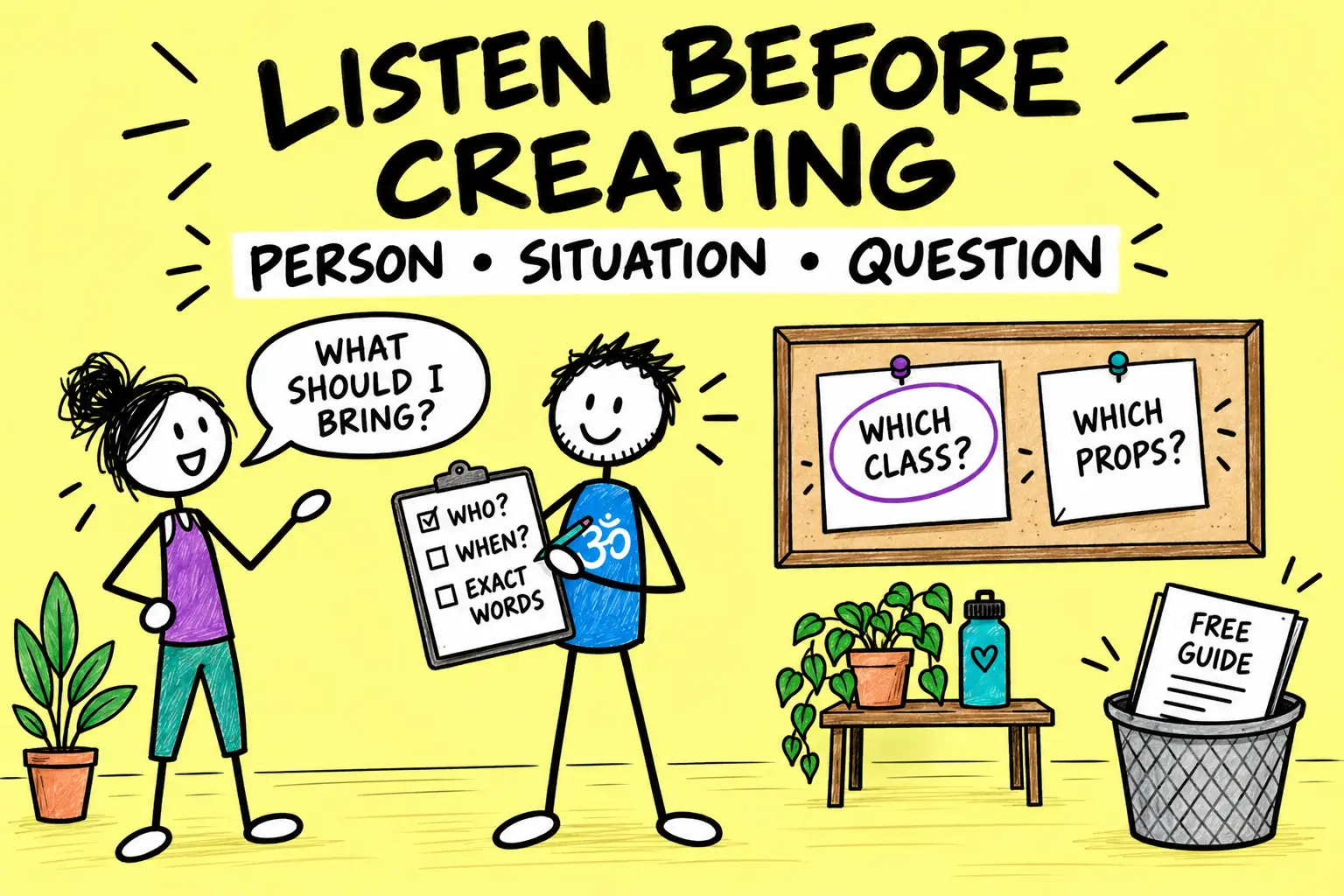
Listen before creating.
Begin with something students already ask. Notice the questions that appear after class, in emails and before workshops: “What should I bring?”, “How can I remember that sequence?” or “Which class is suitable for me?”
- Write down the person
- Name the situation
- Record their exact question
- Choose one question to answer
Example: “New students are unsure which props to bring to the community hall.” This is clearer than “I need a free yoga guide.”
Choose One Small Outcome

Finish one sentence.
Write: After using this resource, the reader can…
A small outcome prevents the resource becoming a dumping ground for everything you know. “Arrive prepared for their first class” is manageable. “Understand yoga” is not.
- Know what to bring
- Repeat a taught sequence
- Choose a suitable class
- Prepare useful questions
Pick the Simplest Useful Format
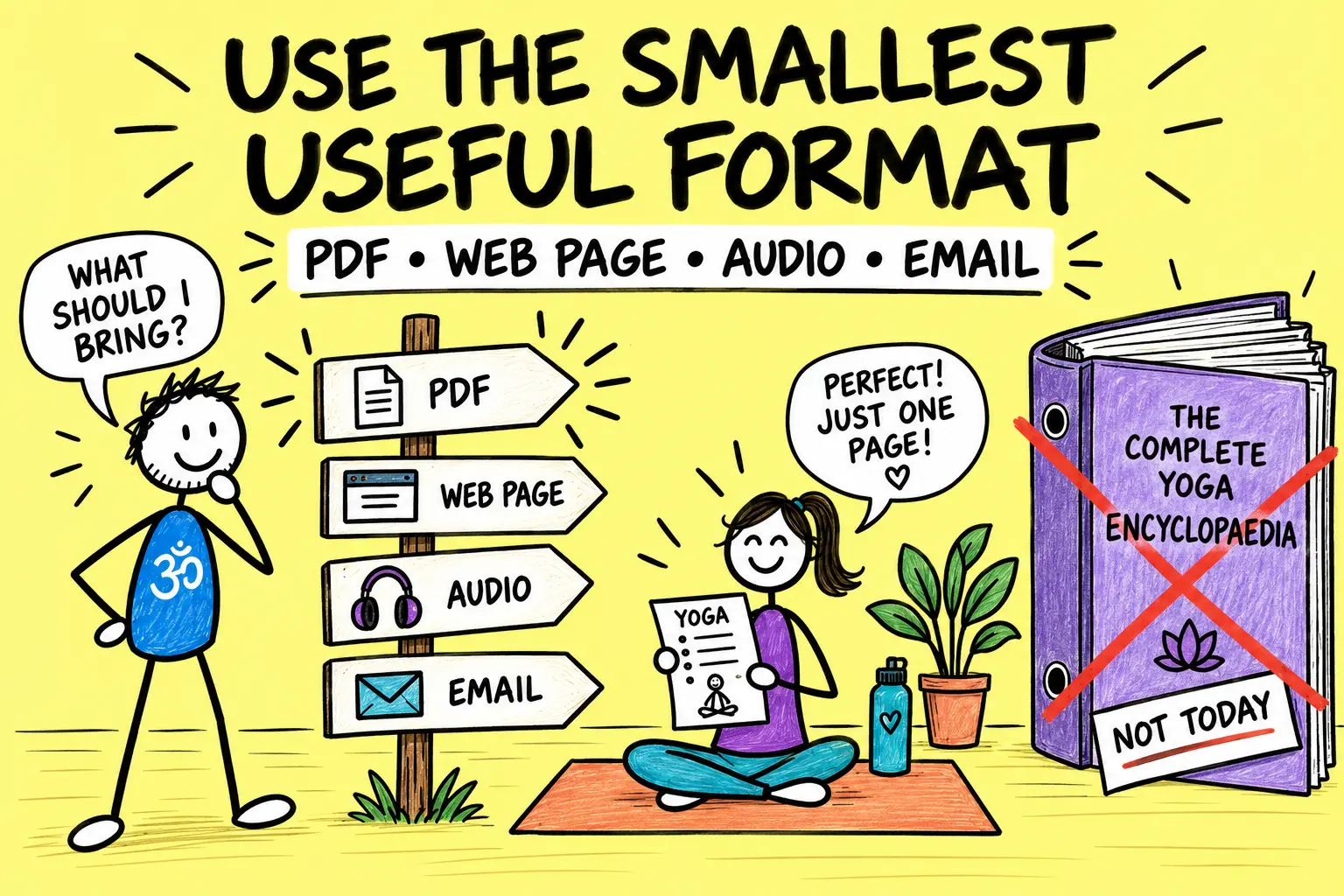
Match the format to the job.
The original article suggested handouts, lesson plans, blog posts, eBooks, audio and video. Those formats still work. The useful question is which one removes the most friction for this particular reader.
One-Page PDF
A checklist, class recap or printable reminder.
Web Page
Information that needs links, updates or search visibility.
Short Audio or Video
A guided relaxation, breathing reminder or setup that is easier to hear or see.
Practical information needed at a particular moment before or after class.
Choose the smallest useful format.The giant binder in the doodle is not a compulsory stage of content creation.
Add First-Hand Teaching Value
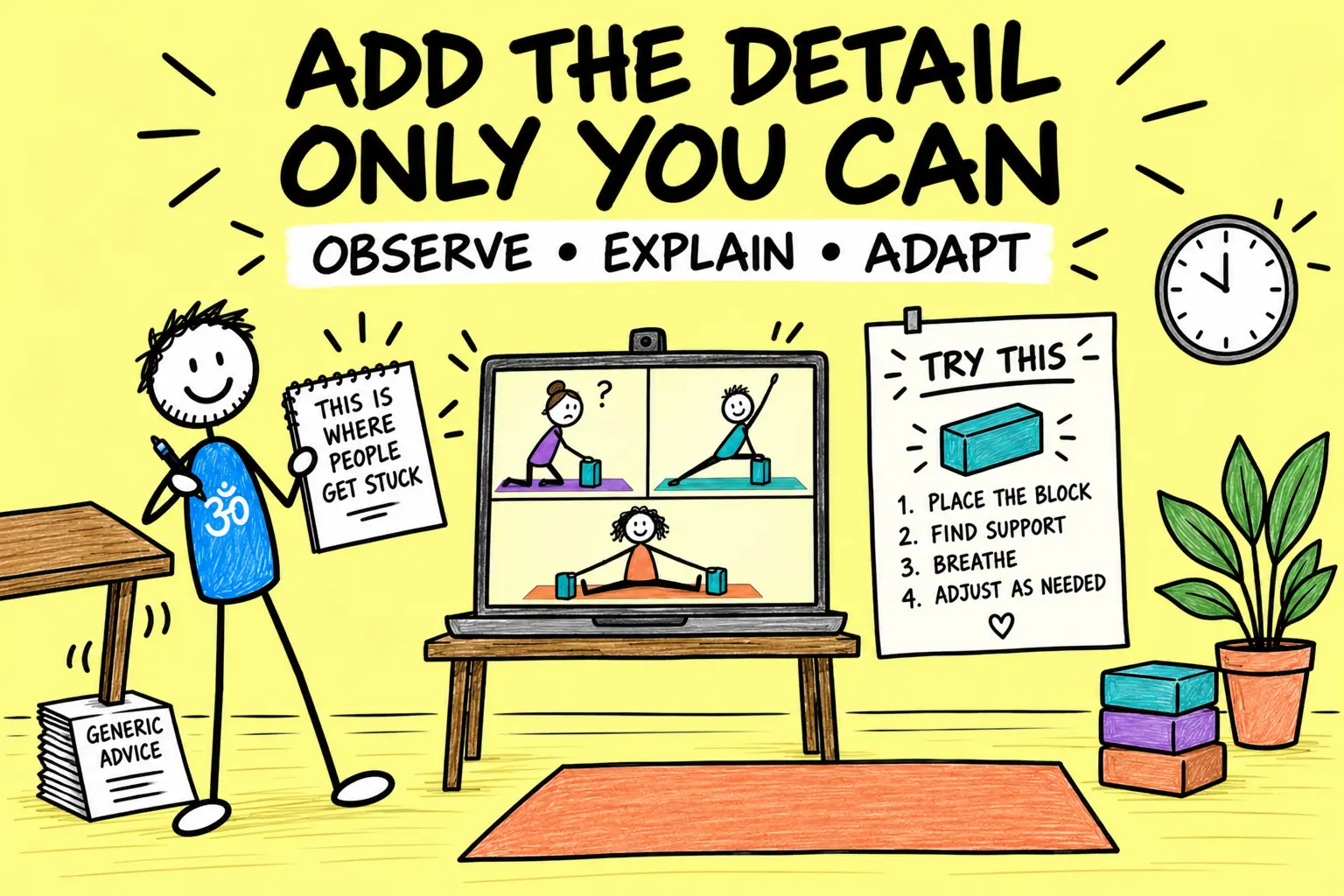
Include the detail only you can add.
Generic information is easy to find. Your contribution is what comes from teaching: what students commonly misunderstand, how you explain a choice, what they should expect at your venue and where a simple adaptation may help.
Use real observations and examples, but do not turn one student’s experience into a universal result. Get permission before sharing identifying stories, photographs, testimonials or recordings.
If the resource belongs on your website, the completed yoga teacher blogging guide shows how to turn teaching knowledge into a clear post.
Check Safety, Scope and Accuracy

Read it without yourself in the room.
A free resource still carries your name. Review it once as a teacher and once as a person encountering it without you present.
- Say who it is for
- Explain important limitations
- Avoid promises or diagnoses
- Check sources and links
- Confirm image and music rights
- Add a date when useful
Keep general information distinct from individual advice, and make it clear when somebody should speak to an appropriately qualified professional.
Make It Easy to Use

Remove every avoidable obstacle.
Give the resource a descriptive title, a short introduction and one obvious action. Use readable type, plain language and enough white space. Check it on a phone as well as a computer, then ask one person to try it without your help.
- Test every link
- Check every download
- Add your contact route
- Use a clear file name
- Check the mobile version
- Replace outdated versions
Plan Your Yoga Resource in 20 Minutes
Answer eight prompts to shape one useful handout, audio, video, email or class guide.
Type directly into the fields. When you finish, use your browser’s Print command and choose Save as PDF, or copy the answers into your working document. Your answers stay in this browser page and are not submitted to GeorgeWatts.org.
Share It Without Pressure
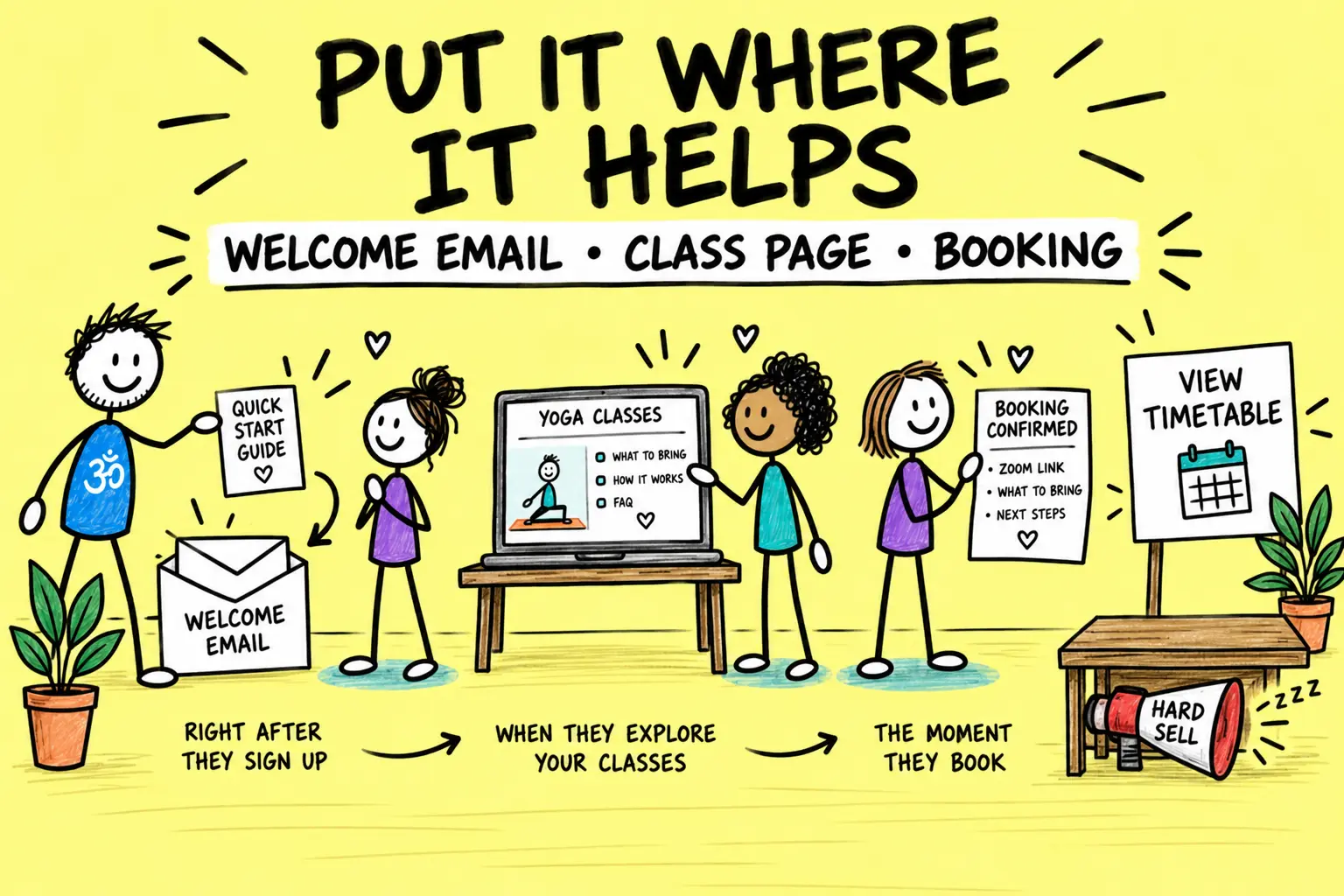
Put it where it is naturally needed.
Share the resource on a class page, in a welcome email, beside a workshop booking or as a direct response to a question. An ungated resource is often the simplest form of help.
If you invite people to receive emails, explain what you will send and how often, and make leaving the list easy. The completed yoga teacher email marketing guide covers the wider relationship.
End with one relevant next step: view the timetable, reply with a question, book a suitable class or explore a related paid resource. Helpful clarity is not the same as a hard sell.
Measure Helpfulness, Then Improve

Measure the intended outcome.
Traffic alone cannot tell you whether a resource worked. Look for the smallest signal connected to its purpose.
- Students arrive prepared
- A repeated question declines
- People complete the useful step
- Readers follow the relevant link
- Replies become more specific
- The information stays current
Keep what helps. Clarify what confuses. Update what dates. Retire what no longer serves anybody. A small library of maintained resources is more credible than a digital cupboard nobody dares to open.
12 Yoga Resource Ideas to Adapt
Choose an idea only when it answers a question you genuinely hear.
- 1First-class checklist
What to bring and what to expect.
- 2Props and venue guide
Parking, access, equipment and practical details.
- 3Workshop packing list
Everything needed before a longer session.
- 4Home-practice reminder
A short recap of material already taught.
- 5Chair setup checklist
Simple preparation for an appropriate chair class.
- 6Short relaxation audio
A familiar practice students can revisit.
- 7Six-week course recap
Key ideas and a sensible next step.
- 8Class-style comparison
Help people choose between your actual classes.
- 9Frequently asked questions
Clear answers to genuine student concerns.
- 10Modification questions
Prompts to discuss with an appropriate teacher.
- 11New-student welcome guide
A calm introduction to your class and venue.
- 12Practice tracker
A simple way to notice consistency without pressure.
Adapt the idea for your students, venue and teaching scope. Generic wallpaper is still wallpaper, even when saved as a PDF.

George’s Conclusion
The useful heart of “give, give, give” is not the number of things you publish. It is the care you take over the one thing somebody needs now.
Start with a question you have genuinely heard. Make the smallest resource that answers it well. Keep the advice safe and honest, make it easy to use, and offer one clear next step. Then listen. Your students will show you what deserves improving next.