

On This Page
George’s Intro
I updated this post in 2026.
One dependable chair yoga sequence can become dozens of fresh classes.
Hi, I’m George. I’m a British Wheel of Yoga teacher, creator of the Online Yoga Lesson Planner and maker of yoga card decks. I’m also mildly obsessed with sticky-note yoga doodles.
I created six Chakra Chair Yoga card decks because chair yoga teachers face two opposite problems.
We need enough familiarity for students to feel secure, but enough variety to stop the lesson plan becoming a photocopy of last Tuesday.
This is a practical course in using the complete six-deck series to create balanced, beginner-friendly chair yoga sequences for community classes, seniors, newcomers, workplace groups, home practice and gentle movement sessions.
You do not have to own all six decks to use the planning ideas. Start with the deck that solves your current problem, then borrow the method for the cards or plans you already have.
FREE CHAIR YOGA SEQUENCING MINI COURSE

What You Will Learn
- What each of the six decks contributes.
- How to keep 80% of a reliable sequence and refresh 20%.
- How to build with individual pose cards, mini-flow cards or both.
- How to turn one starting route into six different classes.
- How to adapt the result for the students who actually arrive.
Jump to the Fresh Sequence Formula ↓
Why Chair Yoga Sequences Become Repetitive
Repetition is useful until it becomes automatic.

Familiar movements can help students feel secure, follow instructions and notice progress. A regular opening or closing can also give the class a reassuring shape.
The problem begins when the purpose, movement order and teaching choices stay unchanged because the teacher has run out of planning ideas.
| Useful repetition | Planning on autopilot |
|---|---|
| Students revisit a movement with a clearer cue. | The same cue is repeated whether or not it helps. |
| A familiar pose supports a new variation. | Every pose appears in the same place each week. |
| The teacher keeps what suits the group. | The plan is used without considering who arrived. |
| Repetition serves the class purpose. | Repetition has become the class purpose. |
Cards interrupt that autopilot gently. One visual prompt may remind you of a movement direction, transition, breathing practice or theme you have not used recently.
They are idea generators, not shuffled instructions that must be obeyed.
Meet the Six Chakra Chair Yoga Card Decks
The six decks give you two kinds of planning help.
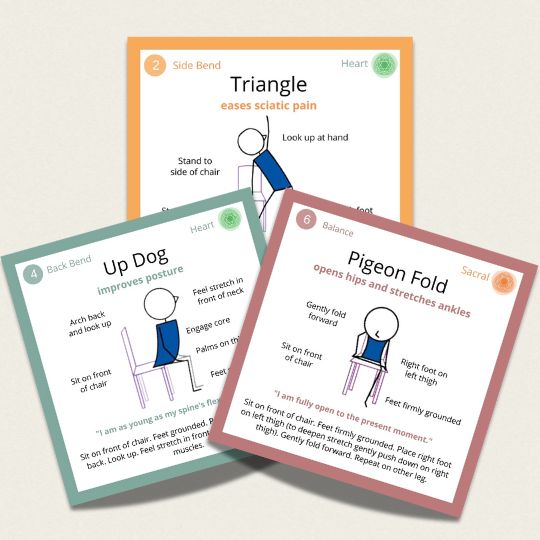
The original deck and Expansion Deck contain individual exercises. Think of them as your ingredients.
The four Mini Flows decks contain ready-made five-pose sequences. Think of those as recipe cards that you can keep, shorten, combine or adapt.
Together, the first two decks provide 104 individual exercise prompts. The four Mini Flows decks provide 120 five-pose flow cards organised around different teaching purposes.

Original Chakra Chair Yoga Deck
52 individual pose cards for building fresh, balanced chair yoga sequences.
Chakra Chair Yoga Expansion Deck
52 more pose cards, plus mantra and mudra prompts, for refreshing familiar routes.

Mini Flows 1: Morning Mobility
30 five-pose flows for energising mobility sessions, daytime classes and lively openings.

Mini Flows 2: Calm Focus
30 five-pose flows for steadier attention, quiet classes and mindful movement.

Mini Flows 3: Evening Restore
30 five-pose flows for softer pacing, evening classes and an unhurried finish.

Mini Flows 4: Heart Opening
30 five-pose flows for posture themes, chest opening and adaptable shoulder pathways.
Which deck solves today’s planning problem?
| If you need… | Start with… | Why |
|---|---|---|
| A complete sequence from individual movements | Original Deck | Its seven categories give the class a clear route. |
| More poses, mantras and mudras | Expansion Deck | It adds 52 prompts and two extra categories. |
| An energising mobility emphasis | Morning Mobility | Its five-pose flows give you a lively starting structure. |
| A steadier, quieter class | Calm Focus | It supports concentration without demanding complexity. |
| An evening or gentle class | Evening Restore | It helps you create a slower route towards rest. |
| A posture or chest-opening theme | Heart Opening | It gives you related flows that can be adapted by range. |
The product pages show the current purchase formats and prices. Each deck can be used alone, so you do not need all six before you begin.
Use the 80/20 Sequence Rule
Keep most of the route familiar and refresh one useful part.

A practical target is roughly 80% familiar and 20% new. The exact percentages do not matter. The principle does.
Keep the arrival, dependable transitions, two or three anchor movements and the closing your students already understand. Change one movement family, one short flow or one teaching idea.
The Fresh Sequence Formula
Use five decisions to turn a card idea into a teachable plan.

STEP 1
Name the class purpose
Decide what students should practise, notice or leave with.
Example: Choose energising mobility this week, then a calmer focus next week.
STEP 2
Keep the anchors
Retain the opening, familiar transitions and closing that already work.
Example: Keep your usual seated arrival, ankle mobility, easy twist and breathing finish.
STEP 3
Choose one deck
Match the deck to the class purpose rather than choosing at random.
Example: Use a Morning Mobility flow for the energising class, then a Calm Focus flow for the slower class.
STEP 4
Edit before adding
Remove anything that does not suit the group, chair, room or available time.
Example: Remove the middle three movements before inserting one five-pose flow.
STEP 5
Rehearse the route
Check both sides, transitions, props, alternatives and the ending.
Example: Rehearse the new middle and confirm that the familiar anchors still make the route feel recognisable.
Four Simple Ways to Build a Sequence With Cards
Choose the method that matches how much planning help you need.

METHOD 1
Build from individual exercise cards
Use the original Chakra Chair Yoga Card Deck, the Expansion Deck or both.
Sort the cards by category. Choose a warm-up, side bend, twist, gentle backbend, forward bend, balance or strengthening movement, then a breathing or closing prompt.
Lay them out in a beginning, middle and end. Move or remove cards until the transitions make sense.
Best for: teachers who want complete control over every movement.
METHOD 2
Use the Three-Card Mini Flow System
Choose one Warm-Up card, one Main Flow card and one Cool-Down card from a Mini Flows deck.
You now have three short sequences rather than a blank page. Decide how long to spend on each, whether any movements repeat and what needs changing.
Add another Main Flow card for a longer class. Remove movements rather than rushing if the class is shorter.
Best for: teachers who want a strong starting structure quickly.
METHOD 3
Keep your plan and replace the middle
Take a class you already teach confidently.
Keep its arrival, warm-up and closing. Choose one Mini Flow card that suits the day’s purpose and use it to replace a stale middle section.
Check whether the flow introduces movements already used elsewhere. If it does, remove the duplicate or use the repetition deliberately.
Best for: escaping routine without rebuilding the whole lesson.
METHOD 4
Use a mini flow as the theme, then add individual cards
Choose a Mini Flow card to establish the class purpose.
Then use the original or Expansion Deck to add one preparation movement, one accessible alternative and one closing practice.
The flow provides coherence. The individual cards help you adapt it for the actual group.
Best for: teachers who want inspiration and control at the same time.
A worked hybrid example
Suppose you choose a Heart Opening Main Flow card.
From the original deck, add a gentle warm-up that prepares the shoulders. From the Expansion Deck, add a mudra that supports the theme. Finish with a familiar breathing practice your students already know.
Rehearse the whole route. If the middle asks for too much repeated arm lifting, remove one movement. If a student cannot comfortably lift their arms, plan a lower pathway before you teach.
Turn One Starting Sequence Into Six Different Classes
One dependable route can lead to six genuinely different lessons.
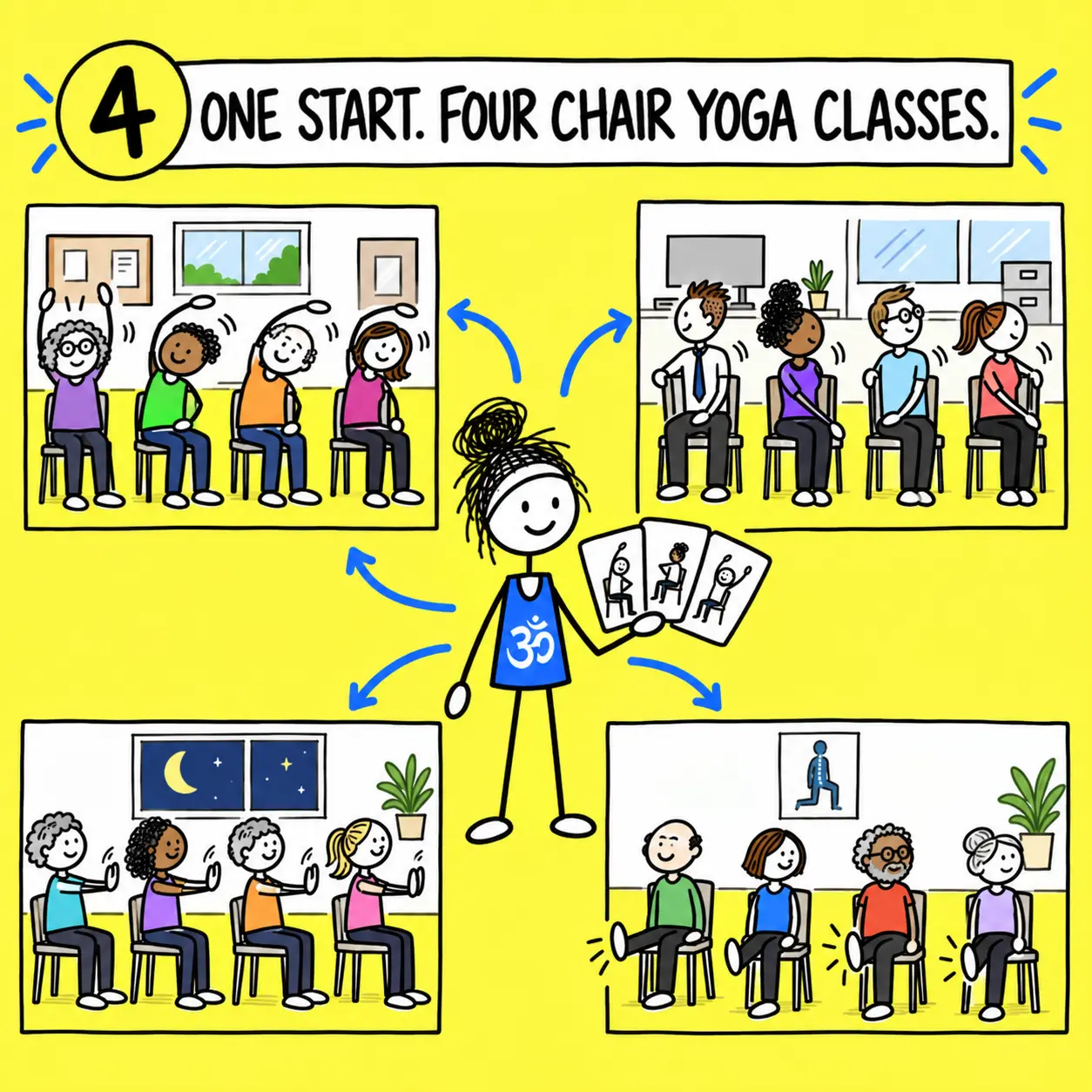
Imagine the starting route is: seated arrival, ankle mobility, arm raise, side bend, easy twist, gentle backbend, forward fold, supported balance and breathing.
Now let each deck change one purposeful part.
Plan 1: Balanced foundation
Deck: Original Chakra Chair Yoga Card Deck.
Keep: the clear seven-category route.
Remove: any card that repeats the same movement direction.
Add: one alternative for the balance card and a clear breathing finish.
Plan 2: Fresh ideas
Deck: Expansion Deck.
Keep: the arrival, ankle mobility, twist and closing.
Remove: three middle movements used in the previous class.
Add: one new side bend, one balance, one mudra and a short mantra.
Plan 3: Morning mobility
Deck: Morning Mobility.
Keep: the familiar arrival and breathing finish.
Remove: the original middle section.
Add: one mobility flow, repeated once with smaller and larger options.
Plan 4: Calm focus
Deck: Calm Focus.
Keep: the seated base and clear beginning.
Remove: unnecessary changes of position.
Add: one focus flow, slower repetitions and a simple breath count.
Plan 5: Evening restore
Deck: Evening Restore.
Keep: the twist, forward fold and closing breath.
Remove: the stronger balance if it changes the mood.
Add: one restorative flow, longer pauses and an unhurried finish.
Plan 6: Heart opening
Deck: Heart Opening.
Keep: the warm-up and familiar closing.
Remove: repeated overhead actions.
Add: one heart-opening flow with low, medium and wider arm pathways.
The cards have not created six finished lessons by themselves.
They have made the options visible, which lets you compare, remove, rearrange and adapt more easily.
Build a Six-Week Chair Yoga Course
One deck can carry an entire six-week course.
Choose the course below that matches the deck you own and the group you teach. You only need to bring one deck for the full six weeks.
Keep the same arrival ritual, two anchor movements and closing practice throughout the course. Let the chosen deck supply a small, purposeful change each week.
Course 1: Original Chakra Chair Yoga Deck
Use the individual exercise cards to build a balanced route and then refine it over six weeks.
| Week | Class emphasis | Familiar 80% | Fresh 20% |
|---|---|---|---|
| 1 | Build the basic route | Use your usual arrival and breathing finish | Choose a simple beginning, middle and end from the deck |
| 2 | Side body and rotation | Keep Week 1’s opening, transitions and closing | Replace two middle cards with a side bend and twist |
| 3 | Balance and confidence | Keep the route students now recognise | Add one balance card with seated and supported options |
| 4 | Repeat with more awareness | Use the same cards as Week 3 | Slow the pace and repeat fewer movements more carefully |
| 5 | Student favourites | Keep the dependable class shape | Bring back two cards the group enjoyed most |
| 6 | Best-of course | Keep the strongest anchors from all five weeks | Choose the clearest final route and rehearse every transition |
Course 2: Chakra Chair Yoga Expansion Deck
Use the extra exercise, mudra and mantra prompts to refresh a familiar chair yoga structure.
| Week | Class emphasis | Familiar 80% | Fresh 20% |
|---|---|---|---|
| 1 | Explore the deck | Use your normal arrival, anchors and closing | Select a small group of new cards that suit the class |
| 2 | Refresh the middle | Keep the Week 1 beginning and end | Replace three familiar middle movements with new cards |
| 3 | Balance and steadiness | Keep the transitions students understand | Add one balance prompt with clear support options |
| 4 | Mudra theme | Keep the movement route from Week 3 | Choose one mudra and return to it during the class |
| 5 | Mantra theme | Keep the same arrival and main anchors | Add one short mantra at the beginning or closing |
| 6 | Best-of expansion | Keep the most successful movements and pacing | Combine the group’s favourite new prompts into one plan |
Course 3: Mini Flows 1, Morning Mobility
Use one deck of ready-made five-pose flows to create an energising six-week mobility course.
| Week | Class emphasis | Familiar 80% | Fresh 20% |
|---|---|---|---|
| 1 | Establish the course rhythm | Use one arrival and one closing throughout | Choose one comfortable Morning Mobility flow |
| 2 | Repeat and refine | Repeat the Week 1 route | Offer a smaller and a larger range for each movement |
| 3 | A new mobility route | Keep the arrival, pacing and closing | Replace the main flow with a second card from the deck |
| 4 | Movement with rhythm | Repeat the Week 3 flow | Change the number of repetitions without adding more poses |
| 5 | A longer mobility class | Keep the familiar opening and first flow | Add one carefully chosen second flow if time allows |
| 6 | Favourite morning route | Keep the course’s best-known movements | Choose the group’s favourite flow and teach it with confidence |
Course 4: Mini Flows 2, Calm Focus
Use the Calm Focus deck to build familiarity, steadier attention and unhurried movement.
| Week | Class emphasis | Familiar 80% | Fresh 20% |
|---|---|---|---|
| 1 | Arrive and settle | Use a simple seated arrival and familiar closing | Choose one Calm Focus flow as the centre of the class |
| 2 | Slower repetition | Repeat the Week 1 route | Use fewer repetitions and allow more time to notice each movement |
| 3 | A fresh focus flow | Keep the same arrival, anchors and ending | Choose a second flow from the same deck |
| 4 | Breath and attention | Repeat the Week 3 movements | Add a comfortable breath count to one familiar section |
| 5 | Quiet coordination | Keep the established pace and closing | Repeat one flow with a simple attention cue |
| 6 | Calmest course route | Keep the prompts that helped the group settle | Build the final class around the most successful flow |
Course 5: Mini Flows 3, Evening Restore
Use the Evening Restore deck to shape six classes that gradually become simpler and calmer.
| Week | Class emphasis | Familiar 80% | Fresh 20% |
|---|---|---|---|
| 1 | Create a clear downshift | Use a dependable seated arrival and quiet finish | Choose one Evening Restore flow for the middle |
| 2 | Reduce unnecessary effort | Repeat the Week 1 route | Remove one transition and allow more settling time |
| 3 | A second restorative route | Keep the same opening and closing | Choose another flow from the deck |
| 4 | Slow the transitions | Repeat the Week 3 movements | Teach the route at a more unhurried pace |
| 5 | Protect the ending | Keep the best-known movements | Use fewer cards and reserve more time for stillness |
| 6 | Favourite evening route | Keep the calmest parts of the course | Repeat the group’s preferred flow with minimal new instruction |
Course 6: Mini Flows 4, Heart Opening
Use the Heart Opening deck to explore posture and breathing space through several comfortable arm pathways.
| Week | Class emphasis | Familiar 80% | Fresh 20% |
|---|---|---|---|
| 1 | Comfortable posture | Use a familiar arrival and breathing finish | Choose one Heart Opening flow with a modest range |
| 2 | Low arm pathways | Repeat the Week 1 route | Explore hands-on-thighs and low-arm versions |
| 3 | A second heart-opening flow | Keep the same arrival, anchors and closing | Choose another flow from the deck |
| 4 | Several movement ranges | Repeat the Week 3 flow | Offer low, medium and wider choices without changing the purpose |
| 5 | Posture and breath | Keep the course’s most familiar route | Add one breath cue to the selected flow |
| 6 | Favourite heart-opening route | Keep the options students used confidently | Build the final class around the most useful flow and arm pathways |
Use one course at a time
Choose one table, not all six.
At the end of each lesson, note one movement the group enjoyed, one transition that felt awkward and one idea for the following week.
Carry the successful movement forward as part of the familiar 80%. Replace or simplify the awkward transition, then use another card from the same deck for the fresh 20%.
Real-World Chair Yoga Planning Examples
The same card can do a different job in a different room.

These examples show the practical decisions a teacher might make. They are starting points, not prescriptions.
Weekly community class
A teacher knows the group enjoys a familiar seated warm-up but has begun anticipating every movement.
She keeps the first ten minutes, draws one new twist card and one new side-bend card from the Expansion Deck, then chooses the clearer transition between them.
One new pair of movements refreshes the middle without unsettling the beginning or end.
Care-home session
The teacher chooses a Morning Mobility flow but notices one movement asks for more shoulder range than the group usually finds comfortable.
He keeps the lower-body movements, swaps the overhead action for hands sliding along the thighs and repeats the most successful movement instead of filling the time with more cards.
Fifteen-minute workplace class
The teacher starts with one Calm Focus Main Flow card.
She adds a posture check before it and three comfortable breaths after it. The session remains short because she does not add a second flow merely because another card is available.
Evening class after a busy day
The teacher selects an Evening Restore Main Flow card, then checks whether its transitions still feel calm when taught at half speed.
He removes one change of position, repeats a quieter seated movement and protects the final minutes for stillness.
Heart-opening theme with mixed shoulder mobility
The teacher uses a Heart Opening card as the theme, not as a demand for everyone to make a large shape.
She teaches a low arm pathway, a hands-on-thighs version and an optional wider movement. Everyone follows the same intention through a different range.
Mature beginners who value routine
The teacher keeps the same arrival, ankle movements and closing for the entire month.
Each week, he changes only one middle card. He gives the new movement more explanation and leaves the rest of the route familiar.
A mixed-ability class
The teacher chooses an original-deck balance card and rehearses three ways to teach it.
One version remains seated, one uses the chair for support and one offers a little more challenge. The class shares one purpose without everyone copying the same shape.
A class that has become too complicated
The teacher has placed five Mini Flow cards on the table because they all look useful.
She chooses the one flow that best serves the purpose, saves two for future classes and puts the other two back. Variety comes from better choices, not from squeezing in more material.
For a ready-made example of adapting a short card flow, see Chair Yoga for Grounding.
For a reusable beginning, middle and end, use the Chair Yoga Class Formula.
Check the Sequence Before You Teach
A fresh idea still needs a teacher’s judgement.

- Purpose: Does every major section support what the class is meant to practise?
- Transitions: Can students move between cards without rushed repositioning?
- Both sides: Have you planned repetitions clearly for left and right?
- Chair and room: Is the chair sturdy, the floor non-slip and the space appropriate?
- Options: Is there a comfortable smaller version or a pause when needed?
- Timing: Have you protected enough time for a proper closing?
- Repetition: Are repeated movements serving a purpose rather than appearing accidentally?
- Exit route: Can a student stop a movement and return to a comfortable position easily?
If the sequence looks clever on the table but awkward in your body, change it.
Rehearse the transitions yourself before expecting students to follow them. Use fewer cards if that gives the group more time to understand, repeat and feel the movement.
The 20 Chair Yoga Teaching Tips covers practical setup and adaptations.
The Yoga Lesson Planning Hub can help when you need a different route into the planning process.
George’s Conclusion
Use the decks to escape the blank page, not to replace your judgement.
The original and Expansion decks give you 104 individual ingredients. The four Mini Flows decks give you 120 ready-made five-pose recipes.
You can build card by card, use the Three-Card System, replace the middle of an old favourite or combine a mini flow with carefully chosen individual cards.
Keep the dependable 80%. Add a thoughtful 20%. Then rehearse, adapt and teach the people who actually arrive.
If you want to turn those ideas into a saved visual plan, use the Online Yoga Lesson Planner.
