On This Page
George’s Intro
A balanced class becomes easier to plan when you stop asking one enormous question and answer twelve small ones.
Hi, I’m George. I’m a British Wheel of Yoga teacher, creator of the Online Yoga Lesson Planner and maker of yoga card decks.
We yoga teachers have spent so long drawing stick figures in our yoga lesson plans that they feel like old friends.
Naturally, I’ve snuck them into my sticky-note doodles to make the useful bits of this post easier to remember. Small yellow spaces for big ideas that stick.
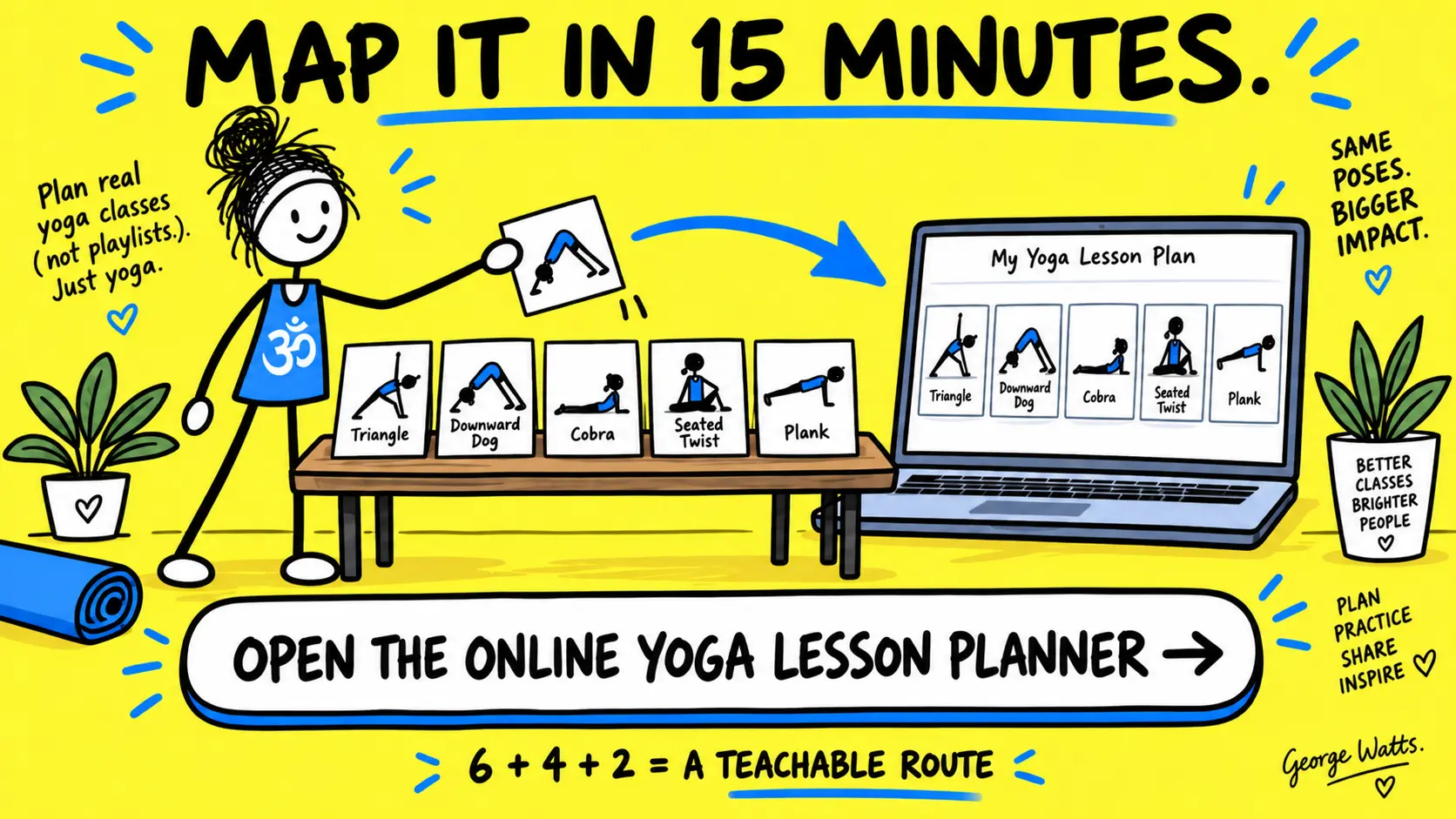
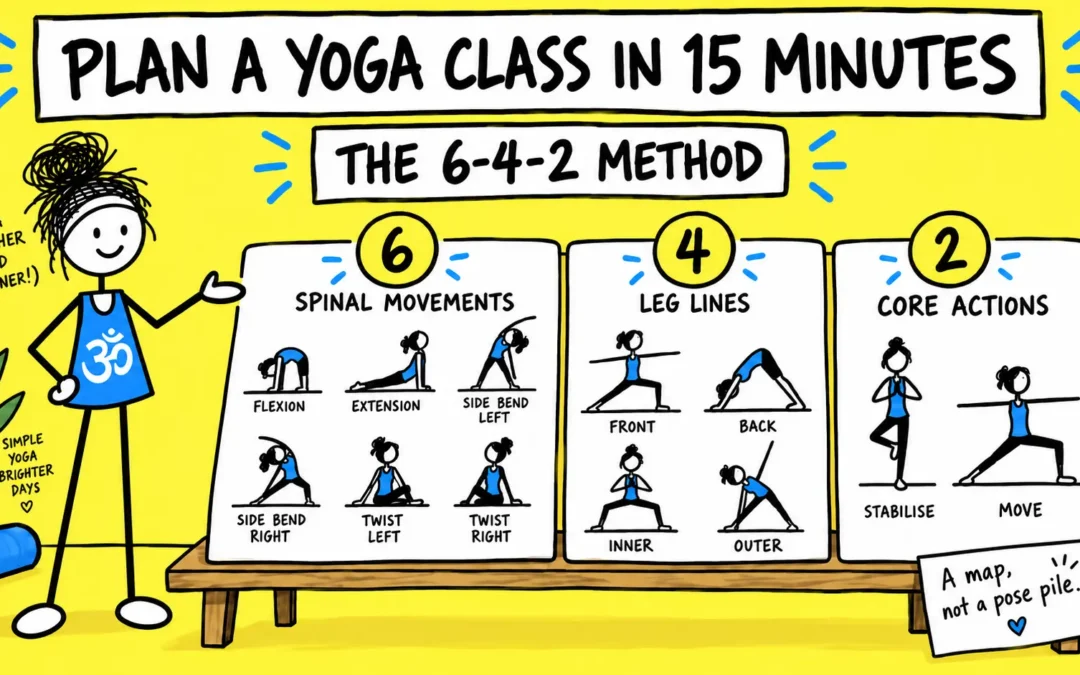
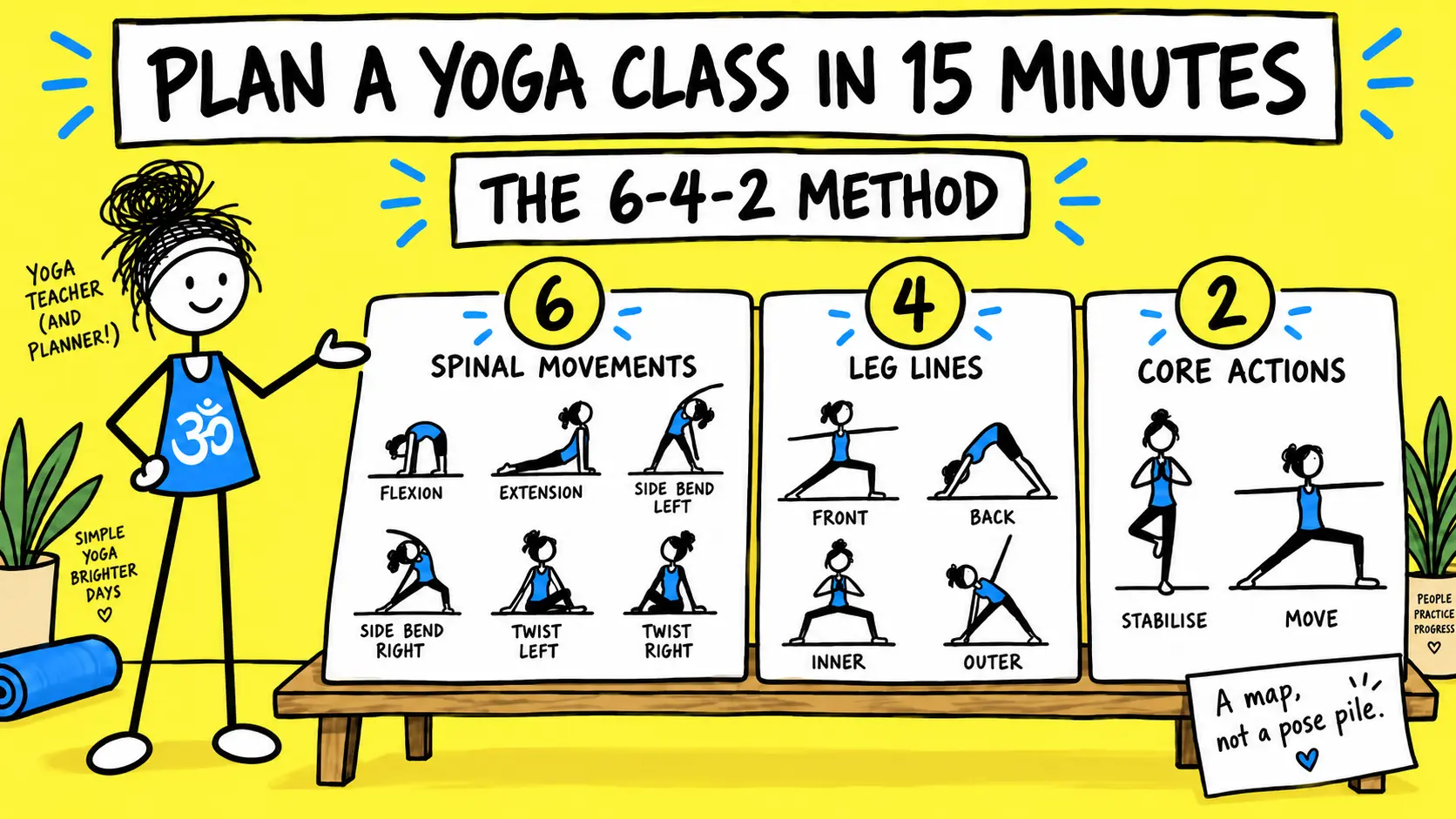
The 6-4-2 yoga lesson planning method checks six spinal movements, four leg lines and two core actions before you arrange the choices into a teachable route.
It can help you map the bones of a class in 15 minutes or less. It does not replace your training, knowledge of the students or the decisions you make while teaching.
Jump to the editable 6-4-2 class map ↓
The 6-4-2 Method at a Glance
Think of 6-4-2 as a quick map of movement, not a finished sequence.
Spinal movements
Flexion, extension, side bend left, side bend right, twist left and twist right.
Leg lines
Choose work for the front, back, inner and outer lines of the legs.
Core actions
Choose one action that stabilises and one action that moves the trunk with control.
Those twelve checks expose obvious gaps while the plan is still easy to change.
They also stop the familiar planning habit of collecting favourite poses first and discovering the route later.
Map the Class in 15 Minutes
Give each planning decision a small time box so the blank page cannot become the whole evening.
1. Name the class
Write the students, class length and one clear aim.
2. Fill the six
Choose a comfortable example for each spinal direction.
3. Fill the four
Add one useful choice for each leg line.
4. Pick the two
Add one stabilising and one moving core action.
5. Build the route
Order the choices from arrival to warm-up, main work, cooling and rest.
6. Protect the ending
Check that the plan leaves enough time to cool down and finish.
At fifteen minutes, stop adding. Read the route once, mark anything that needs rehearsal and move on to the teaching details that genuinely matter.
Start With Six Spinal Movements
The six checks are the three main spinal movement patterns counted in both directions where a side is involved.
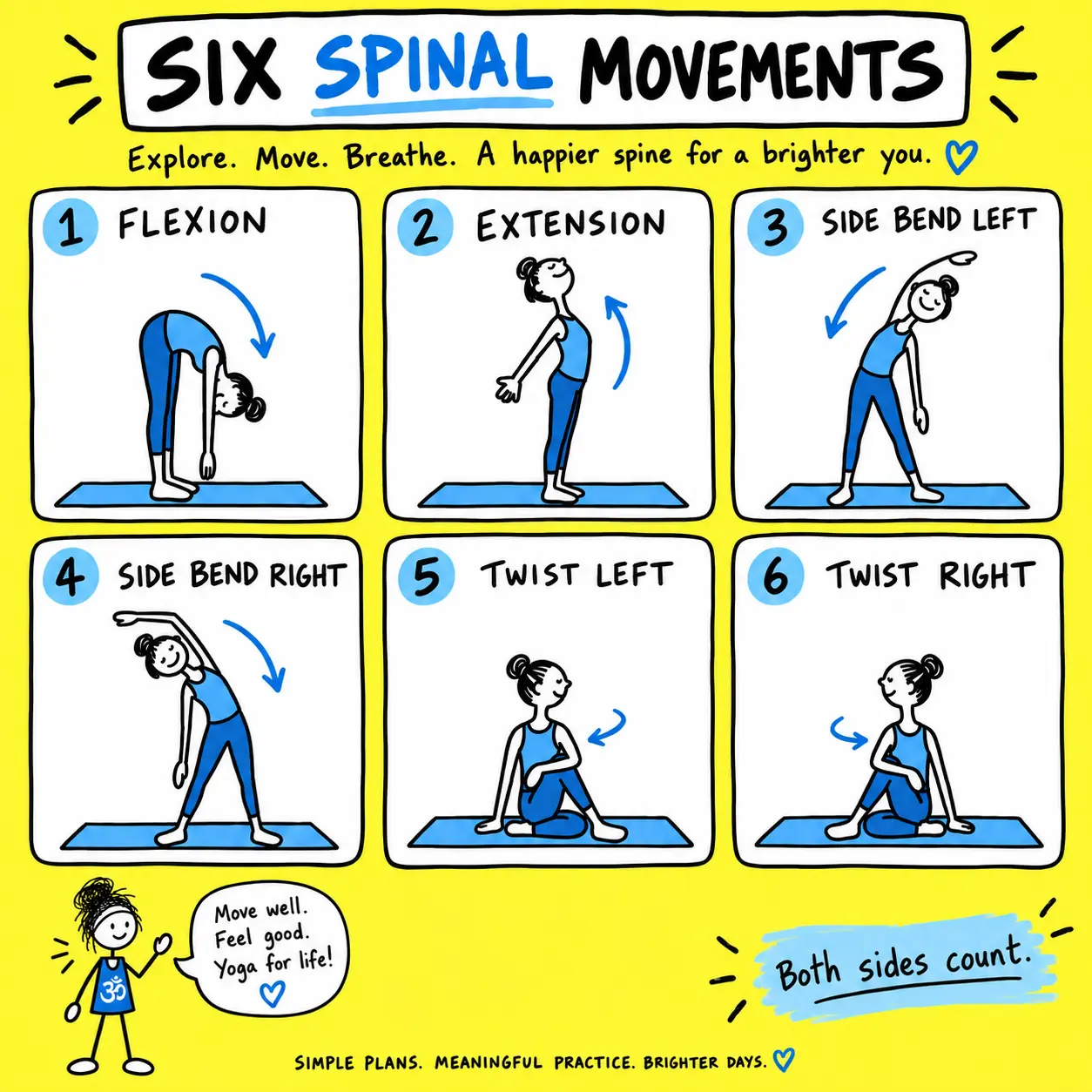
Flexion
Round or fold the spine with control.
Examples: Cat-Cow, Standing Forward Fold, Seated Forward Fold, Wide-Leg Forward Bend, Child or Hare.
Extension
Open the front body and move the spine into a backbend that suits the class.
Examples: Cat-Cow, Cobra, Locust, Bow, Camel, Bridge or Upward Facing Dog.
Side bend left
Lengthen one side of the trunk without collapsing the other.
Examples: Gate, Standing Side Bend, Crescent Moon, Extended Side Angle or Hero Side Bend.
Side bend right
Repeat the lateral movement on the second side.
Examples: Gate, Standing Side Bend, Crescent Moon, Extended Side Angle or Hero Side Bend.
Planning check: note the side instead of writing “both” and hoping.
Twist left
Choose a rotation that fits the position and purpose of the class.
Examples: Easy Twist, Seated Twist, Half Lord of the Fishes I, Lying Twist, Revolved Triangle, Revolved Chair or High Lunge Twist.
Twist right
Repeat the rotation on the second side without forcing symmetry.
Examples: Easy Twist, Seated Twist, Half Lord of the Fishes I, Lying Twist, Revolved Triangle, Revolved Chair or High Lunge Twist.
Planning check: allow different ranges while keeping the route clear.
You do not need six spectacular poses. A slow Cat-Cow can cover flexion and extension, and one simple side bend or twist can be repeated in both directions.
Add Four Leg Lines
The four leg lines are a practical scanning tool for the front, back, inner and outer legs.
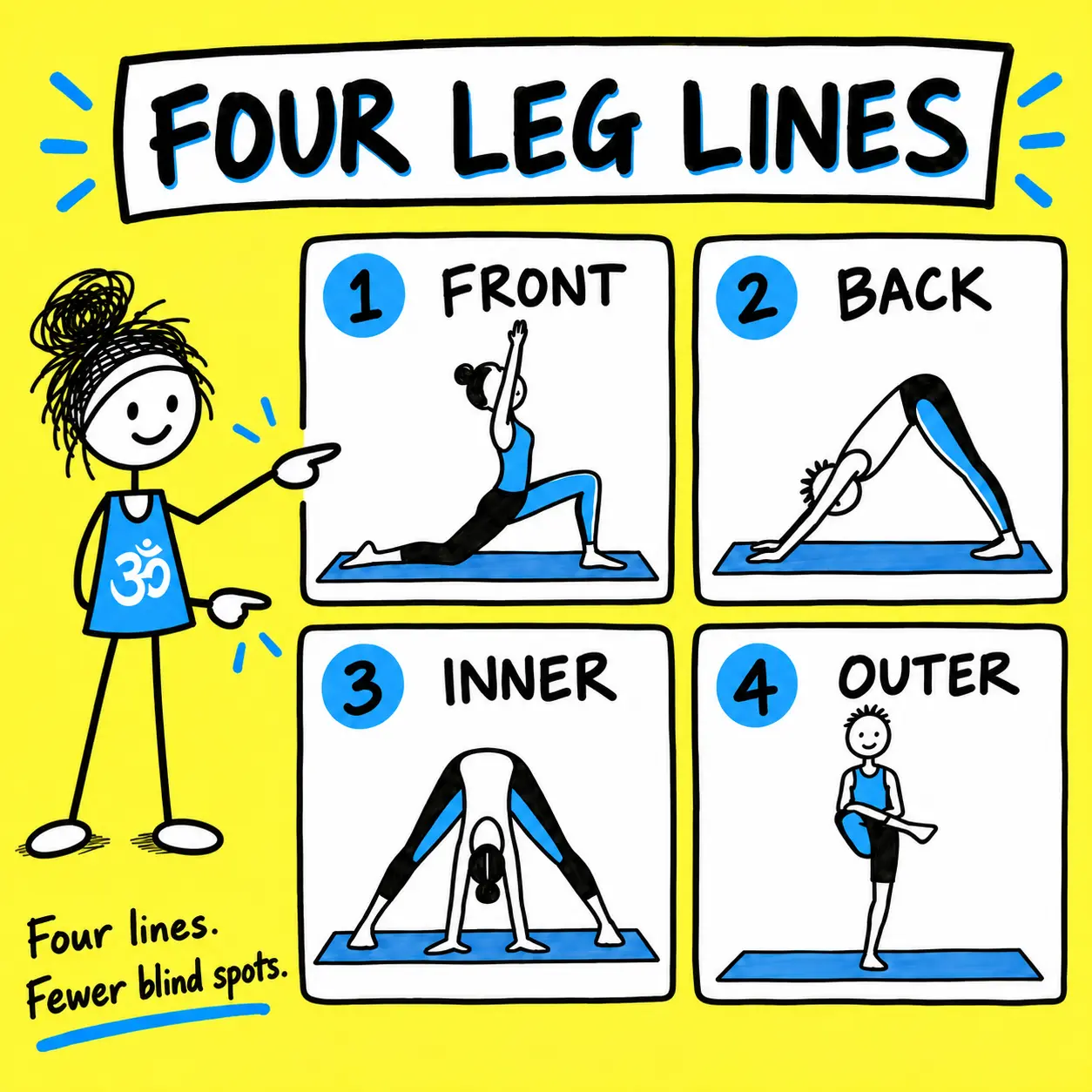
Front line
Choose a shape that asks something useful of the front of the hips or thighs.
Examples: Low Lunge, Crescent Lunge, Dancer, Camel, Bow or Reclined Hero.
Back line
Include a shape for the backs of the legs without making depth the goal.
Examples: Downward Facing Dog, Standing Forward Fold, Seated Forward Fold, Pyramid, Wide-Leg Forward Bend or Heron.
Inner line
Add a wide or side-to-side shape that brings attention to the inner legs.
Examples: Bound Angle, Goddess Anjali Mudra, Frog, Side Lunge Anjali Mudra, Wide-Leg Forward Bend or Reclined Bound Angle I.
Outer line
Choose a shape that involves the outer hip or lateral support.
Examples: Figure Four, Half Pigeon, Cow Face, Eagle, Supine Pigeon I or Standing Pigeon.
This is a planning lens, not a claim that every student should feel every pose in one exact place.
The question is simply: have I paid attention to more than the same familiar forward-facing shapes?
Choose Two Core Actions
Pick one action that stabilises the trunk and one that moves it deliberately.
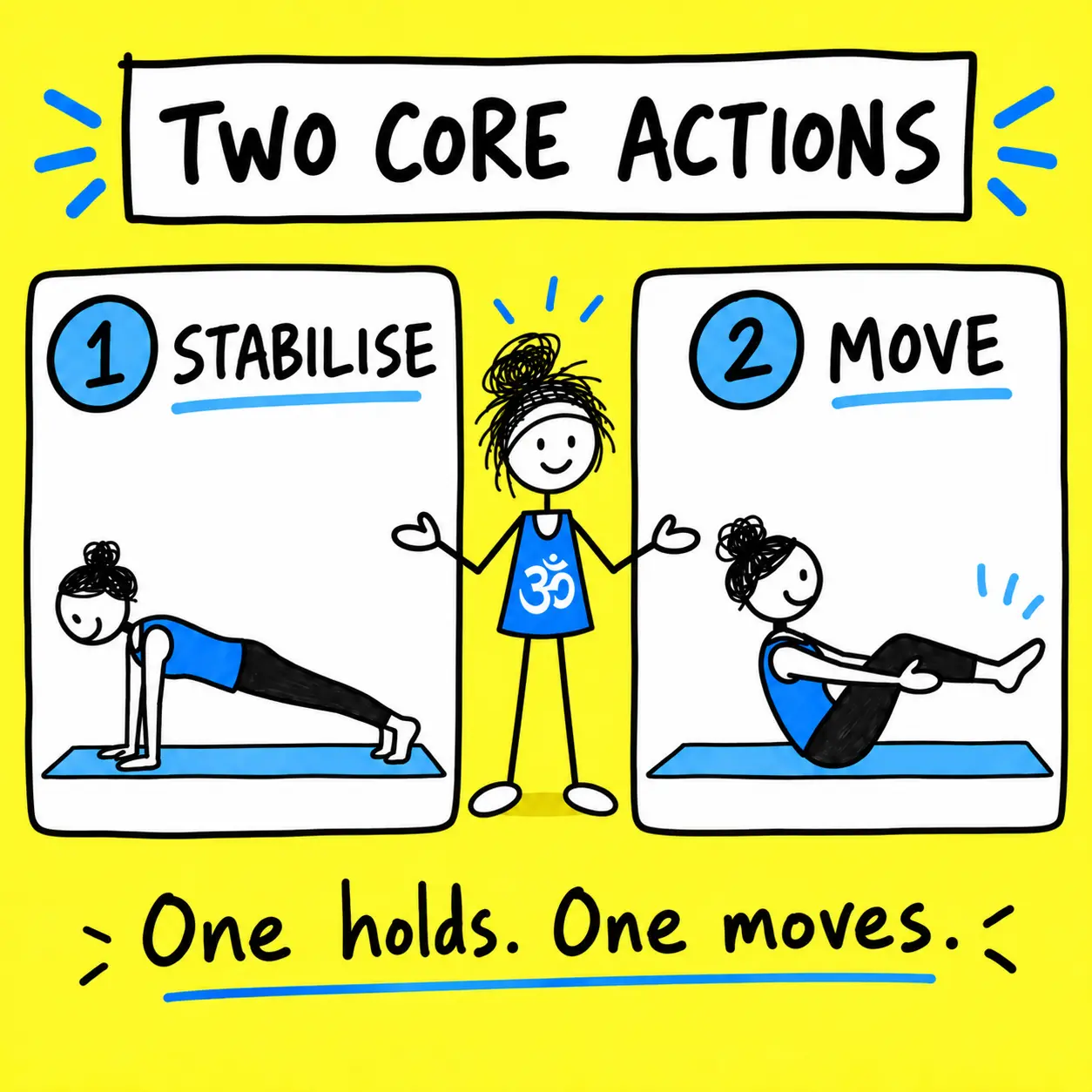
Stabilise
Ask the trunk to stay organised while the limbs or gravity create a challenge.
Examples: Plank, Plank on Forearms, Side Plank, Side Plank on Knees, Dolphin, Dead Bug or Bird Dog Band.
Move
Ask the trunk to flex, extend or rotate through a controlled action.
Examples: Downward Facing Dog Knee to Nose, Side Plank Knee Crunch, Bird Dog Circle, Boat, Bridge Spine Curls, Goddess Squat Twist or Cobra Twist.
These two choices prevent “core work” from becoming a random hard pose added near the end.
They can be gentle. The useful question is whether the action supports the class aim and the students in front of you.
Turn the Checks Into a Class Route
The order matters more than the number of boxes you tick.
Move the twelve choices into a beginning, middle and end. Combine overlapping movements so the class feels like one lesson rather than a checklist being performed at students.
Arrive
Choose a simple starting position, breathing focus and the first easy spinal movement.
Prepare
Introduce the movement directions, joints and leg actions needed later.
Build
Place the main standing, balance or strength work where students are warm but not rushed.
Integrate
Use the two core actions and any useful repeated movement to connect the theme.
Cool
Reduce effort, complexity and pace before the final rest.
Finish
Leave enough time for rest, breath and a clear transition out of class.
If the route looks crowded, remove poses before reducing the ending. A shorter coherent class is usually easier to teach than a long plan that depends on hurrying.
Three Real-World 6-4-2 Examples
The same formula can produce very different classes.
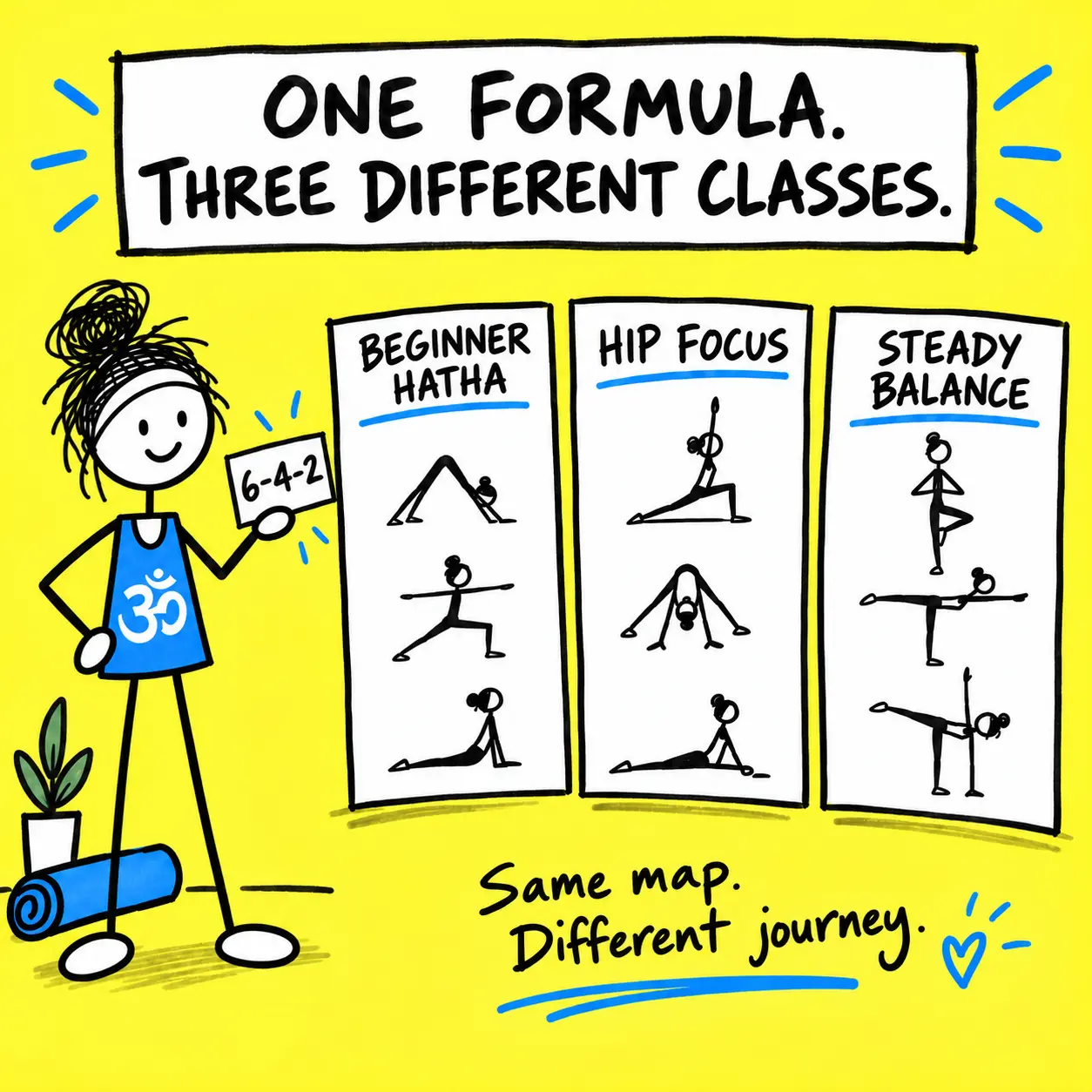
60-Minute Beginner Hatha Class
Real-life situation: a weekly mixed-experience class needs a recognisable route and uncomplicated transitions.
6 spinal movements
Cat and Cow for flexion and extension. Gate on both sides. Easy seated twist on both sides.
4 leg lines
Low Lunge, Downward Facing Dog, Goddess and Supine Figure Four.
2 core actions
Bird Dog to stabilise. Bent-knee Boat lifts to move.
Class route: arrive on all fours, practise Cat-Cow, add Bird Dog, move through Downward Dog to Low Lunge, stand for Goddess and a simple Warrior flow, return to the floor for Boat lifts, Figure Four, Gate, seated twists and Savasana.
Why it works: several poses do two jobs, so the checklist becomes a calm route instead of twelve separate stops.
60-Minute Hip-Focused Class
Real-life situation: the teacher wants a clear hip theme without repeating the same sequence from last week.
6 spinal movements
Standing Fold, Cobra, Gate on both sides and Revolved Low Lunge on both sides.
4 leg lines
Low Lunge, Pyramid, Wide-Legged Fold and Figure Four.
2 core actions
Plank to stabilise. Downward Dog knee-to-nose to move.
Class route: begin with Cat-Cow and Gate, build Plank and Downward Dog, alternate Low Lunge with Pyramid, add a careful revolved option, stand for Wide-Legged Fold, then finish with Figure Four, Cobra, an easy twist and rest.
Why it works: the four leg lines make the hip theme broader than one favourite outer-hip stretch.
45-Minute Steady Balance Class
Real-life situation: a familiar group wants balance practice, but the teacher does not want forty-five minutes of standing on one leg.
6 spinal movements
Ragdoll, Locust, standing side bends on both sides and a small standing twist on both sides.
4 leg lines
Crescent Lunge, Half Split, Goddess and Standing Figure Four.
2 core actions
Plank to stabilise. Slow standing knee drives to move.
Class route: mobilise the spine, practise slow weight shifts, build Crescent and Half Split, add Goddess, use supported Standing Figure Four and knee drives, then visit one or two balance poses before Locust, twists and rest.
Why it works: balance becomes the result of preparation, leg work and trunk control rather than a collection of increasingly difficult poses.
My Editable 6-4-2 Yoga Class Map
Fill the 12 planning checks, then turn them into a beginning, middle and end.
The example choices make a beginner-friendly Hatha route. Edit the final column, then copy or print your map before leaving the page.
My 6-4-2 Yoga Class Map
Edit the “My Choice” section.
15-minute map
| Check | Planning prompt | My Choice |
|---|---|---|
| 6 spinal movements | ||
| 1. Flexion | Round or fold | Cat |
| 2. Extension | Open the front body | Cow or Cobra |
| 3. Side bend left | Lengthen the side body | Gate |
| 4. Side bend right | Repeat on side two | Gate |
| 5. Twist left | Rotate comfortably | Easy seated twist |
| 6. Twist right | Repeat on side two | Easy seated twist |
| 4 leg lines | ||
| 1. Front | Front hip or thigh | Low Lunge |
| 2. Back | Backs of the legs | Downward Facing Dog |
| 3. Inner | Inner legs | Goddess |
| 4. Outer | Outer hip or lateral support | Supine Figure Four |
| 2 core actions | ||
| 1. Stabilise | Hold the trunk steady | Bird Dog |
| 2. Move | Move the trunk with control | Bent-knee Boat lifts |
| Class route | ||
| Beginning | Arrive and prepare | Cat-Cow, Gate and Bird Dog |
| Middle | Build the main work | Dog, Low Lunge, Goddess and simple standing flow |
| End | Cool and finish | Boat lifts, Figure Four, twists and Savasana |
Your edits stay on this page only. Copy or print them before you leave.
What the 6-4-2 Method Does Not Decide
A complete checklist is not automatically a suitable class.
The method does not decide pace, repetitions, breath cues, transitions, props, teaching language or which versions are appropriate for a particular student.
It does not know your students
You still need to consider the people, setting, experience and choices required in the room.
It does not rehearse transitions
Walk through how one position becomes the next. Remove awkward travel when it adds nothing useful.
It does not protect the ending
You must still begin cooling early enough to avoid rushing rest.
It does not require every box
Leave out, reduce or adapt a movement when that makes the class more suitable.
Use the map as a first draft, then apply your training and professional judgement.
For a deeper check, compare the route with my guide to 29 common yoga sequencing mistakes.
George’s Conclusion
The best quick planning method is the one that leaves you with a route you can actually teach.
The 6-4-2 method gives you 12 small decisions: 6 spinal movements, 4 leg lines and 2 core actions.
Map them quickly, combine the overlaps, protect the ending and rehearse the transitions that need your attention.
If you want more yoga lesson planning formulas, yoga sequencing guides and ready-made yoga plans, visit the Yoga Lesson Planning Hub.
Turn the Map Into a Saved Lesson Plan
Use the 6-4-2 checklist to choose your ingredients, then organise, save and print the route in the Online Yoga Lesson Planner.