Browse by category
George’s Intro
Bring your curiosity. I’m George, a BWY yoga teacher, creator of the Online Yoga Lesson Planner, yoga card deck maker and enthusiastic sticky-note doodler.
A pendulum is a small prop that can start a surprisingly big conversation. Add a chakra theme, a notebook and a class willing to ask questions, and you have an opportunity to explore attention, expectation and personal meaning.
This free handout keeps that curiosity while making the purpose clear. It offers a pendulum observation activity and seven optional reflection prompts. There is no requirement to share a belief, produce a particular movement or explain your private reflections to the room.
What Is Chakra Dowsing?
Chakra dowsing uses a pendulum in connection with chakra symbolism. Some practitioners interpret its movements spiritually. This handout treats it as an optional activity for observation and reflection.
Chakras belong to Indian subtle-body traditions. The familiar seven-centre map is one presentation among several; it is not a set of physical organs. Sanskrit scholar Christopher Wallis explains the variety of systems in his introduction to chakra traditions.
The reflection questions in this handout are contemporary teaching prompts. They are not presented as ancient definitions or tests of chakra function.
What Moves the Pendulum?
Small movements can surprise us. A hand-held pendulum can move through tiny, unintentional muscle movements. This is called the ideomotor effect: thinking about or expecting a movement can influence it without a deliberate decision to swing the weight.
Research on hand-held pendulums describes this effect. Seeing a swing does not establish that someone’s energy has been measured or that a chakra is blocked.
You can value a reflective or spiritual experience without using it to assess health. A pendulum is not a diagnostic tool, and its direction should not decide medical treatment or other important life choices.
Try the Activity in Class
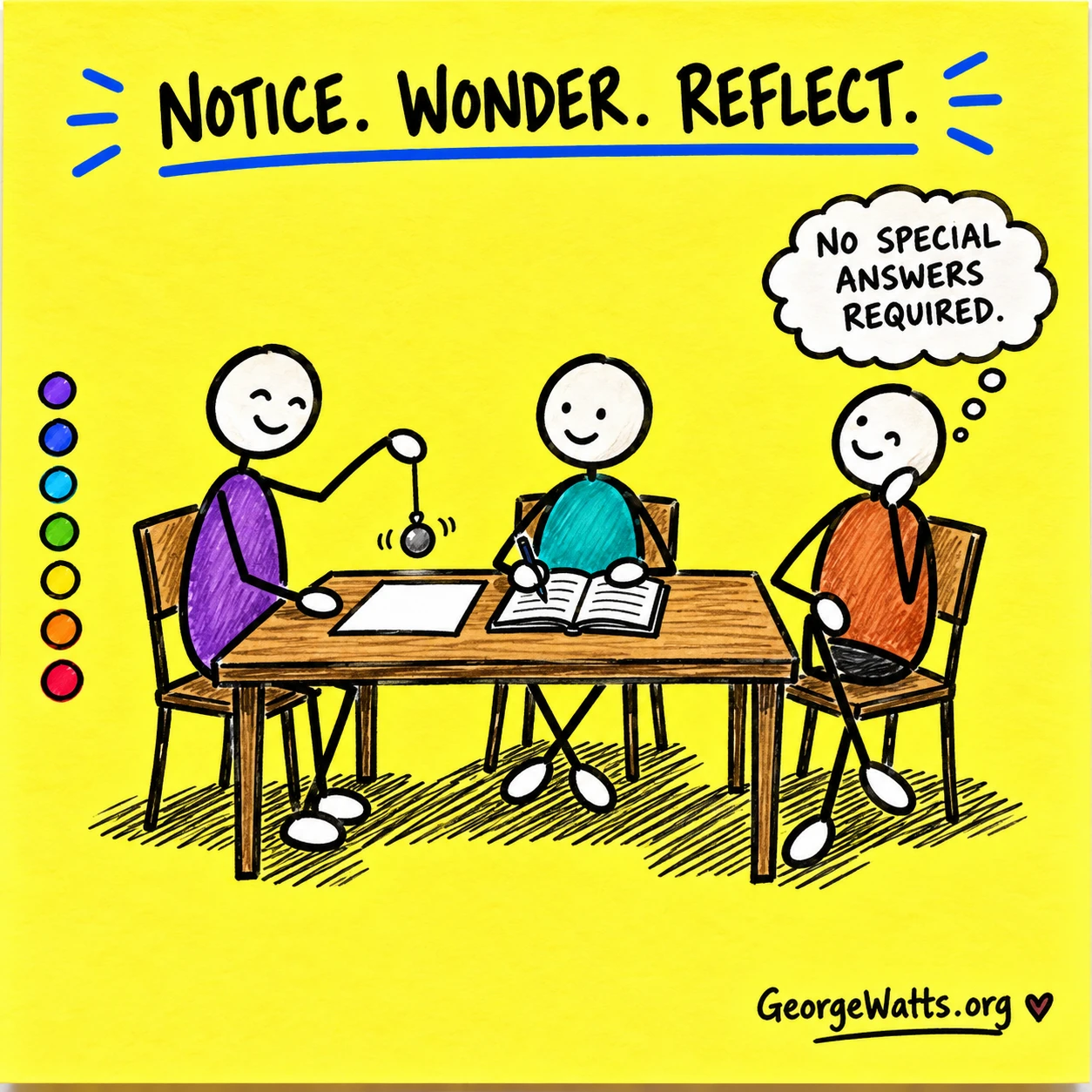
- Set up comfortably. Use a small, smooth weight securely attached to a short string. Sit at a table with room around you.
- Observe over paper. Hold the string in either hand above a blank sheet or chakra list. Support your elbow if helpful. Keep the weight away from faces and other people.
- Write what happened. Record stillness, a line, a circle or an irregular movement. Leave “good”, “bad”, “open” and “blocked” labels out of the observation.
- Set the pendulum down. Choose a reflection question yourself and take a quiet moment to write or think.
Students can observe or use the prompts without a pendulum. The activity does not require holding a weight over a partner’s body, touching anyone or making claims about somebody else’s emotions.
Download the Chakra Dowsing Handout
The two-page handout includes the activity, an explanation of the ideomotor effect and a contemporary seven-centre reflection map. Both versions are editable, with white pages for printing.
Your free Chakra Dowsing handout
Download the Word handout (.docx) ↓
Download the LibreOffice handout (.odt) ↓
Seven Optional Reflection Prompts
Choose one question and give it some space. These modern prompts use familiar chakra names as a structure for reflection.
- Root — Muladhara: What helps me feel supported?
- Sacral — Svadhisthana: Where could I make room for creativity or enjoyment?
- Navel — Manipura: What small action is within my control?
- Heart — Anahata: How could I show kindness while keeping a useful boundary?
- Throat — Vishuddha: What would I like to express clearly?
- Brow — Ajna: What assumption might be worth questioning?
- Crown — Sahasrara: What gives me a sense of meaning or connection?
Let students keep their answers private. A thoughtful question can be enough; the class does not need to arrive at a shared interpretation.
George’s Conclusion
Stay curious. Keep your judgment. This can be a useful conversation about what we notice, what we expect and the meaning we give an experience. Make room for the enthusiast, the sceptic and the person who simply enjoys a quiet moment with a notebook.
Download the handout, choose one question and see where the conversation goes. The pendulum can have a rest while you do the thinking.