Browse by category
George’s Intro
Five ideas. Start with one. I’m George, a BWY yoga teacher, creator of the Online Yoga Lesson Planner, yoga card deck maker and enthusiastic sticky-note doodler.
The five vayus can sound like five more things to remember while you’re teaching. Fortunately, you don’t have to introduce the whole philosophy between “find a comfortable seat” and the late arrival looking for a space.
This free handout gives you a clear introduction and some gentle ways to explore the ideas. Pick one theme, keep the movement familiar and let the class get curious.
What Are the Five Vayus?
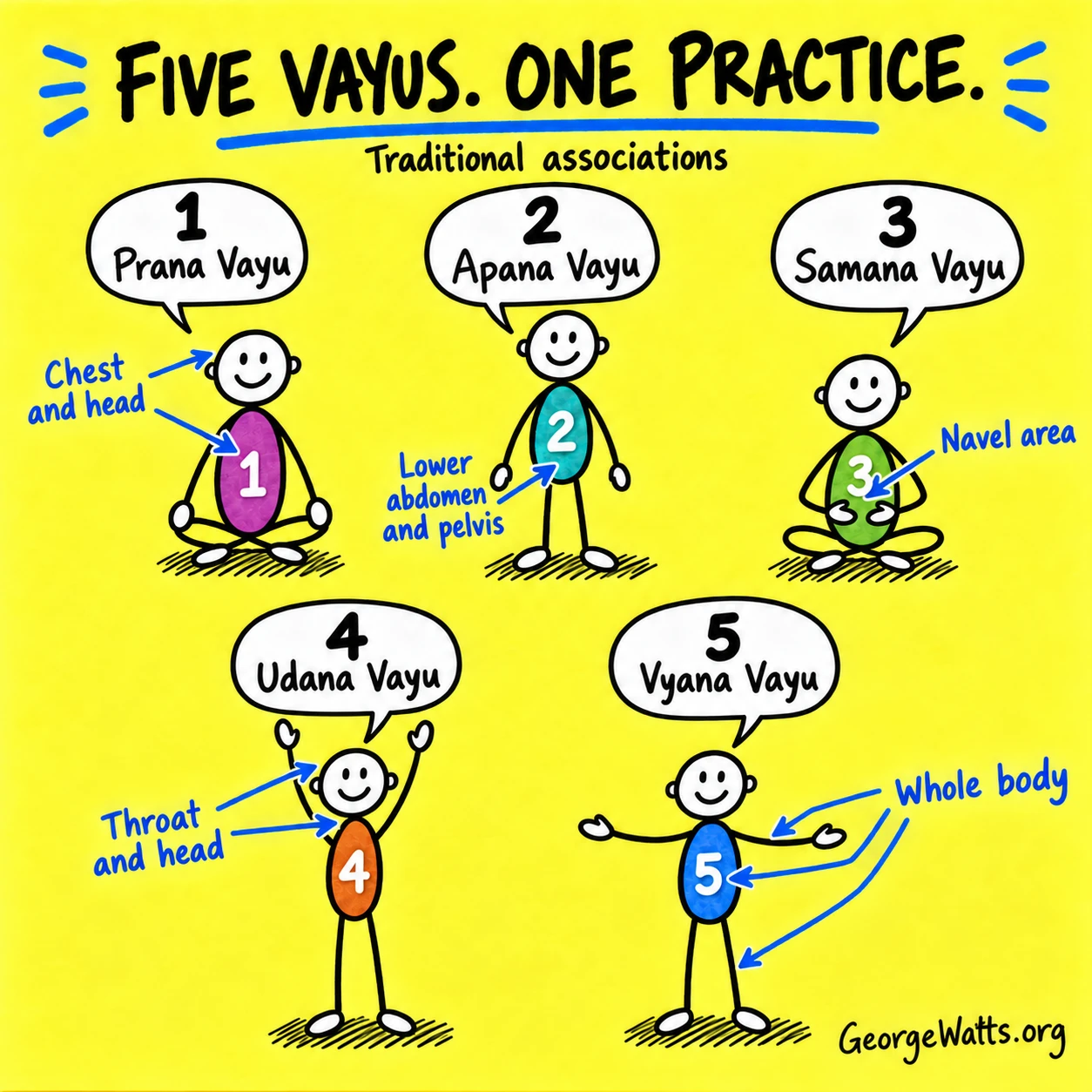
In yoga philosophy, prana refers to vital energy. The five vayus describe functions or movements of that energy; vayu means “wind” or “air”. They belong to a traditional subtle-body model, rather than a medical account of nerves and organs.
Descriptions vary between teachings. The Himalayan Institute’s introduction to the five prana vayus offers one traditional explanation. Here, we use simple classroom cues to make the ideas approachable.
- Prana — receiving: associated with taking in and inhalation.
- Apana — grounding: associated with downward and outward movement.
- Samana — centring: associated with assimilation and the navel region.
- Udana — rising: associated with upward movement and expression.
- Vyana — expanding: associated with distribution throughout the body.
These English cues are invitations for practice, not exact translations. Prana also names vital energy as a whole, as well as the first of the five vayus.
Explore the Vayus in Practice
Keep it simple. Choose a comfortable seat or stand with support nearby. Keep breathing naturally, and adapt or skip any movement.
- Receive. Notice an ordinary breath, a sound or the feeling of contact with your chair. Nothing needs to be made bigger.
- Ground. Feel the support beneath your feet or seat. Let your hands rest comfortably.
- Centre. Pause between movements. Rest a hand near your abdomen if you wish, or leave your hands on your thighs.
- Rise. Find a comfortable upright position. Explore a small arm lift if it suits you; overhead reaching is optional.
- Expand. Open your arms gently to the sides and return. Notice how a small movement changes the feeling of the whole position.
These are contemporary teaching explorations of traditional ideas. They do not test whether a vayu is balanced or promise to change a particular organ’s function.
Use an external focus if watching the breath feels uncomfortable. Stop with pain, dizziness, breathlessness or distress, and follow individual advice about movement or breathing.
Download the Five Vayus Handout
The two-page handout includes a guide to each vayu, a gentle five-part exploration, teaching notes and reflection space. Both versions are editable and use white pages for printing.
Your free Five Vayus handout
Download the Word handout (.docx) ↓
Download the LibreOffice handout (.odt) ↓
Teaching Ideas for Your Class
Choose one theme. Grounding might be the thread through a class of familiar seated and standing movements. Expanding might invite students to explore comfortable changes in arm position. You do not need five separate sequences.
Offer choices early. Give the seated option alongside the standing one. Keep smaller movements just as welcome as larger ones.
Ask about experience. “What did you notice?” gives students more room than telling them what energy they should have felt. “Nothing much” is a perfectly usable answer.
Leave advanced methods for study. This handout does not teach breath retention, forceful breathing, bandhas or kundalini awakening techniques. A short introduction can stand on its own.
George’s Conclusion
Let the theme help. The five vayus offer different ways to bring attention to a familiar practice. They don’t need to become a vocabulary test or another thing for your students to get right.
Download the handout, choose one cue and see what your class makes of it. You can save the other four for a day when nobody has forgotten their glasses.