
George’s Intro
Your mat is very patient. Unfortunately, it cannot unfurl itself. Mine has occasionally waited while I finished “just one more thing”—a phrase with surprisingly elastic boundaries.
I’m George Watts, a British Wheel of Yoga teacher, creator of the Online Yoga Lesson Planner and maker of yoga card decks. I draw sticky-note doodles to squeeze useful yoga ideas into a small space, preferably with room for a joke.
This one is about the negotiations that happen before a practice. Here are a few ways to make starting easier, whether you’re practising yourself or encouraging your students.
Jump to the five-minute practice ideas ↓
The Unfurling Problem

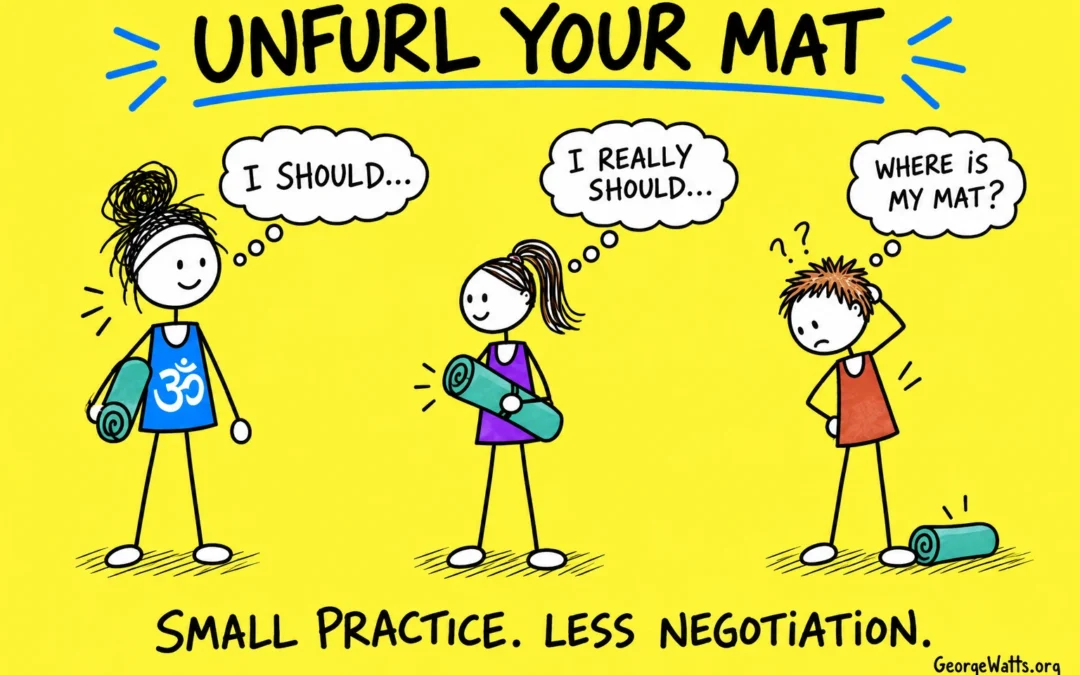
The longer you wait, the harder it can feel to start. My original doodle turns that familiar feeling into a graph. It is a joke about procrastination, rather than a measurement of what happens to your health when you miss yoga.
I’ve used a printout beside my class sign-in sheet as a conversation starter. It invites a smile—and a useful question: what would make a little practice easier today?
Download the free doodle

Make Starting Smaller
Choose something you can actually fit into your day. A few comfortable movements, a quiet seated pause or a short rest can be a starting point. You do not need to audition for a ninety-minute epic.
- Pick a familiar cue. After closing your laptop, before your evening shower or after brushing your teeth might work. Choose one that fits your own day.
- Decide the practice beforehand. “Sit and notice my breathing for two minutes” is easier to begin than “do some yoga”.
- Make the equipment easy to find. Keep a clear, safe space and put any props within reach. Your mat need not become an archaeological discovery.
- Give yourself a small version. On a busy day, shorten the practice or choose a seated option. Adapt it to your energy and circumstances.
- Return without a repayment plan. Missed yesterday? Begin again when it suits you. There is no need to double today’s practice as a penalty.
A small practice is an invitation. A perfect streak is paperwork.
What Regular Practice May Offer
Research suggests yoga may help with stress, sleep, balance and general wellbeing. Results vary between people, styles and programmes; the evidence does not establish that everyone needs daily practice or that twice a day is automatically better.
The NCCIH overview of yoga research and safety is a useful starting point. For this post, the practical goal is to find a manageable routine you enjoy returning to.
Let the practice fit you. Choose familiar, comfortable movements. Stop if something hurts, and seek individual guidance for injuries, medical conditions or pregnancy; yoga should not replace healthcare you need.
My Timer Trick

I use an alarm because I get absorbed in work. In the original version of this post, I described setting it every 25 minutes while writing and drawing. My short practices often lasted between one and ten minutes.
That is my personal reminder system, not a schedule everyone needs to follow. Choose an interval that suits your work, and let the reminder offer a pause rather than issue an order.
A simple desk timer works for me. A phone reminder can work too—provided checking the time does not become an unexpected tour of the internet.
Five-Minute Practice Ideas
Choose one option below. Five minutes is the whole break, including getting comfortable and returning to your day. It is not a requirement to hold a pose for five minutes.
Option 1: Rest in Savasana

Lie comfortably if that position suits you, with support under your knees or head where helpful. Side-lying or sitting in a supportive chair are alternatives.
Let breathing stay natural. You can keep your eyes open, soften your gaze or close them; there is no need to make your mind blank.
A short cue to try
“Notice where you feel supported. Let your next breath arrive without forcing it. If thoughts appear, you have not failed at resting. When you are ready, move gently and take your time coming up.”
Explore Savasana and the bolster-under-knees option in the pose library.
Option 2: A Supported Child’s Pose Pause

If kneeling and folding are comfortable, ease your hips towards your heels and use support beneath your torso or forehead. Keep the shape spacious enough to breathe easily.
Stay only as long as feels comfortable, then change position. Choose seated rest instead if your knees, ankles or breathing do not enjoy this shape.
A pose does not make everyone feel the same way. Invite students to notice their own response rather than tell them they must feel calm or safe.
Explore Child’s Pose in the pose library →
Option 3: Familiar Movement and a Quiet Finish
Try a few gentle shoulder movements, a comfortable seated stretch or another movement you already know well. Leave a little time to sit or rest before returning to your day.
The original article also included Crow Pose. Keep arm-balance practice as a separate, optional skill session with appropriate preparation and teaching support; it is not a quick cold-start exercise or a five-minute hold.
Help Students Find Their Own Starting Point
Give students something specific and achievable. A familiar movement, a comfortable alternative and permission to shorten it are more useful than simply saying “practise every day”.
- Ask which part of today’s class they would like to revisit.
- Help them choose a realistic time and place.
- Offer an option that needs little equipment.
- Ask what they noticed next time, without scoring their attendance at home.
You can share the doodle as a light-hearted reminder. Keep the invitation friendly: a missed day does not need a lecture from a sticky note.
Give Your Next Practice a Simple Plan

Use the Online Yoga Lesson Planner to organise familiar poses into a practice or class plan you can return to and adapt. A clear starting point helps when your brain is busy offering seventeen alternatives.
George’s Conclusion
Unfurl the mat. Lower the entry requirements. Some days you will want to move; other days a comfortable pause may be enough. The useful question is what fits today.
My doodle is a nudge to begin, with a little kindness towards the person doing the unfurling. If your mat has disappeared, finding it can be the first item on the plan.