
On This Page
George’s Introduction
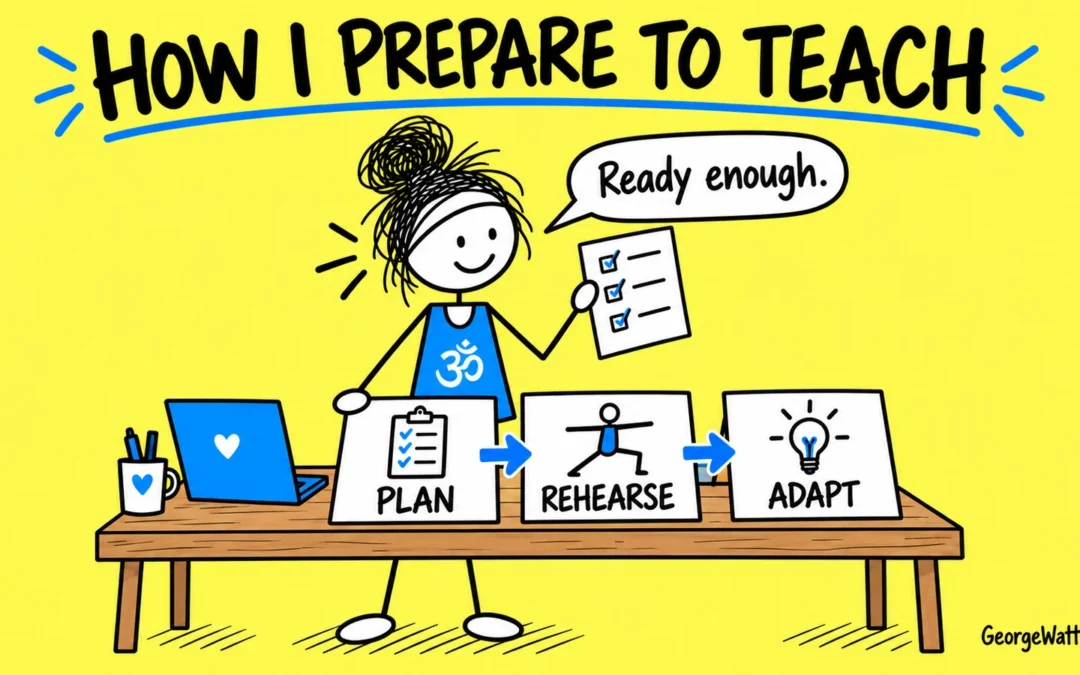
Prepare the route, not a performance. I’m George, a BWY yoga teacher, creator of the Online Yoga Lesson Planner, yoga card deck maker and enthusiastic sticky-note doodler.
Before I teach a yoga class, I want three things: a plan I can understand at a glance, confidence that the sequence works in a real body, and enough flexibility to respond to the people who arrive.
I do not try to memorise an hour of perfect words. I prepare the decisions that matter, then leave room for teaching.
My Three-Step Preparation Routine
Plan, rehearse, adapt. Each step has a different job, which stops preparation becoming one enormous task called “worry about Thursday.”
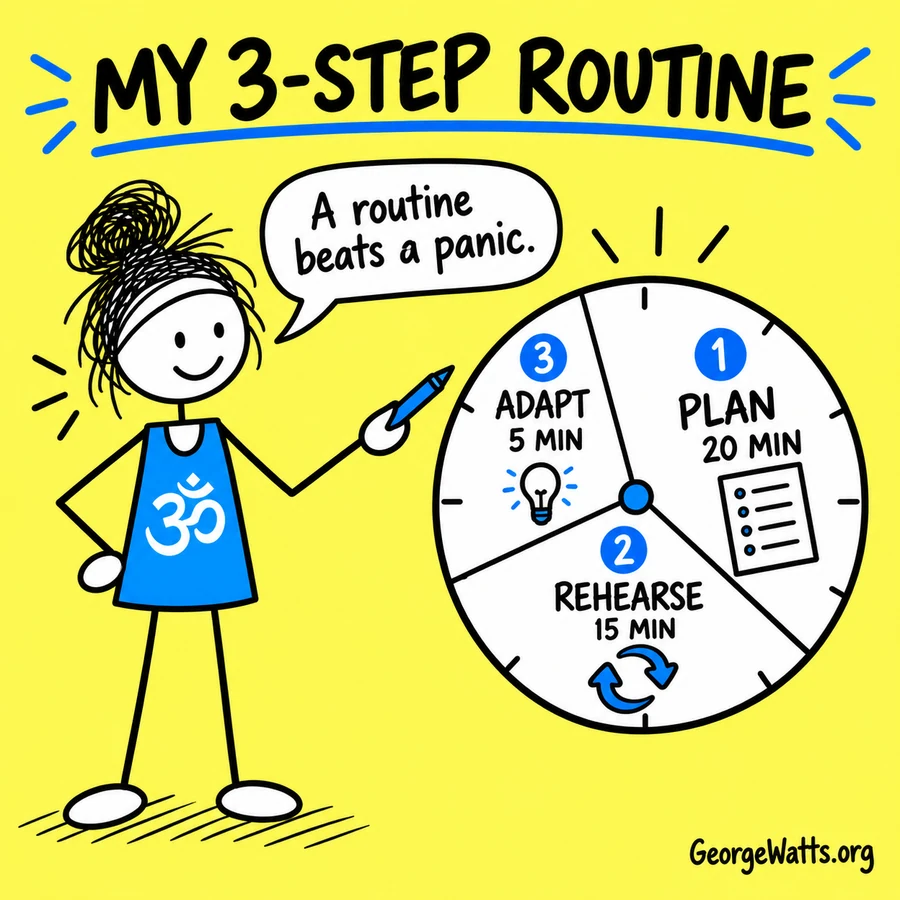
Decide who the class is for, its purpose, the route and your Plan B.
Test the transitions, timing and essential teaching language.
Arrive ready to observe the room and change the plan without panic.
The timings in the doodle are an example, not a rule. A familiar weekly class may need ten minutes. A workshop, specialist group or unfamiliar sequence may deserve much longer.
For example: for a new 60-minute balance class, I might spend 20 minutes building the plan, 15 minutes testing the unfamiliar transitions and five minutes preparing chair-supported options. When I teach the class again, I may only need ten minutes to review my notes and make a few changes.
Step 1: Build a Flexible Yoga Lesson Plan
Make four decisions first. A useful plan begins with people and purpose, not a pile of interesting poses.
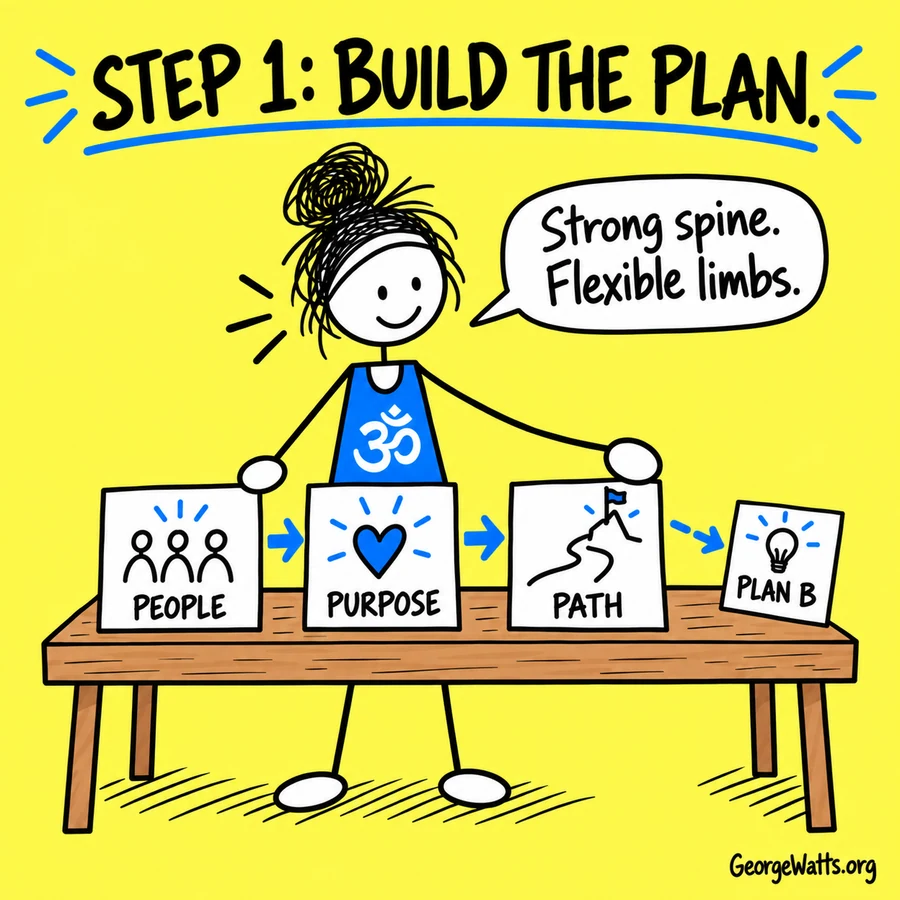
Who is likely to attend? What is the setting, experience level and practical access?
Example: Eight adults in a chilly village hall, mixed experience, with six chairs available.
What is the one movement, skill or quality the class will explore?
Example: Explore steady balance by changing the base of support.
How will students arrive, prepare, explore, reduce demand and rest?
Example: Mountain → heel raises → Low Lunge → supported Warrior III → Tree → forward fold → Savasana.
What can become smaller, slower, better supported or simply be left out?
Example: Use a chair for the balances and remove Warrior III if the class needs more time.
I write the purpose as one plain-language sentence. For example: “Explore steady balance by changing the base of support.” That sentence is much more useful than “teach Tree Pose,” because it leaves several ways to explore the same idea.
Write a plan you can scan
My teaching copy needs landmarks, not paragraphs. I include:
- the opening and main class idea;
- the sequence in a clear order;
- important transitions between positions;
- one or two useful options;
- props and setup notes;
- rough timings, including the final rest;
- one activity I can remove if time runs short.
That is enough information for me to see the whole journey without reading a script. The detailed teaching directions can stay in the longer preparation copy.
If you want a deeper planning checklist, open my 101 yoga class planning tips. If you need the creative starting point, browse 101 yoga class ideas.
Step 2: Rehearse the Class, Not a Script
Test the route. Rehearsal helps me find awkward transitions and unrealistic timings before students have to find them with me.
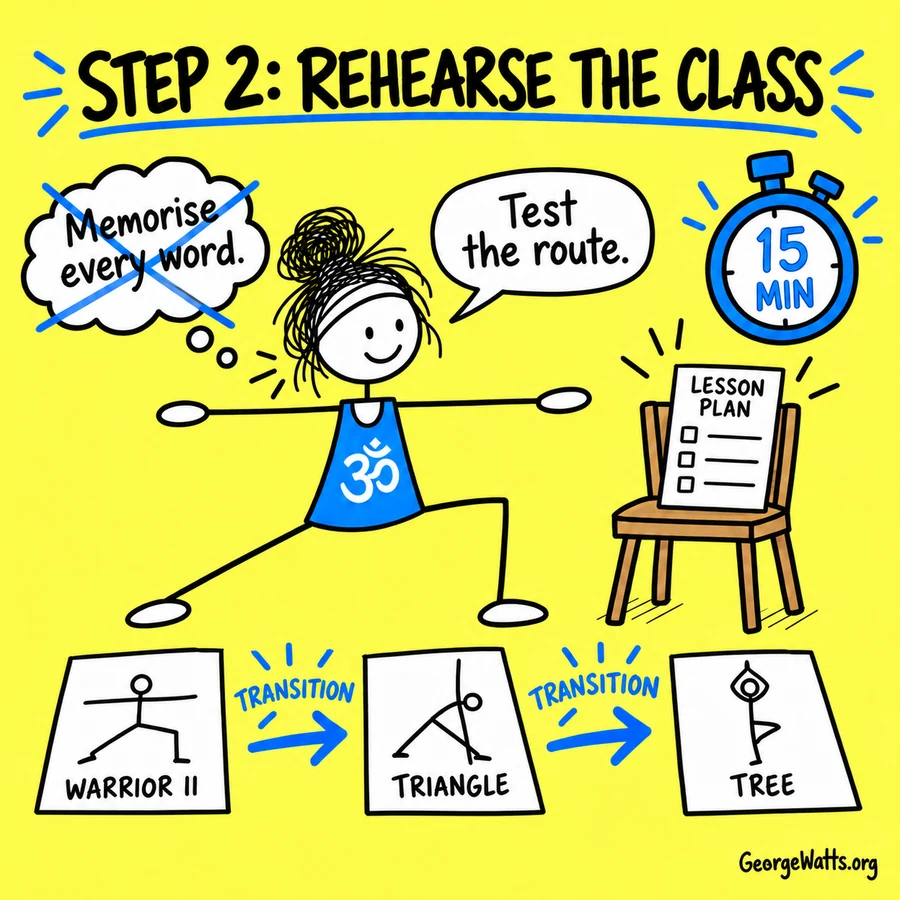
I do not always practise the entire class at full duration. I move through unfamiliar parts, mentally walk through familiar ones and say important instructions aloud. That is usually enough to reveal where the plan is vague.
Can I see the beginning, middle and end without hunting through my notes?
Example: If Savasana is hidden on page two, I circle it and write “start rest at 45 minutes” on page one.
How does the group move between levels, sides, props and activities?
Example: Warrior III straight into Tree feels rushed, so I return everyone to Mountain Pose between them.
Which cue is essential, and which explanation can wait or disappear?
Example: I replace a long balance speech with: “Choose a steady point and keep breathing naturally.”
Notice what rehearsal tells you
When I rehearse, I often discover that I have included too much. I may remove a pose, simplify a transition or give the central exploration more time. That is not a failed plan. It is the plan doing its job before the class begins.
Here is a typical edit. A balance plan might include heel raises, Warrior III, Half Moon and Tree. Moving through it reveals four one-legged activities competing for time. I remove Half Moon, keep the chair-supported Warrior III and give students longer to explore Tree without rushing.
Step 3: Prepare to Adapt in the Room
Keep the plan bendy. The class in your notebook is imaginary; the people walking through the door are real.
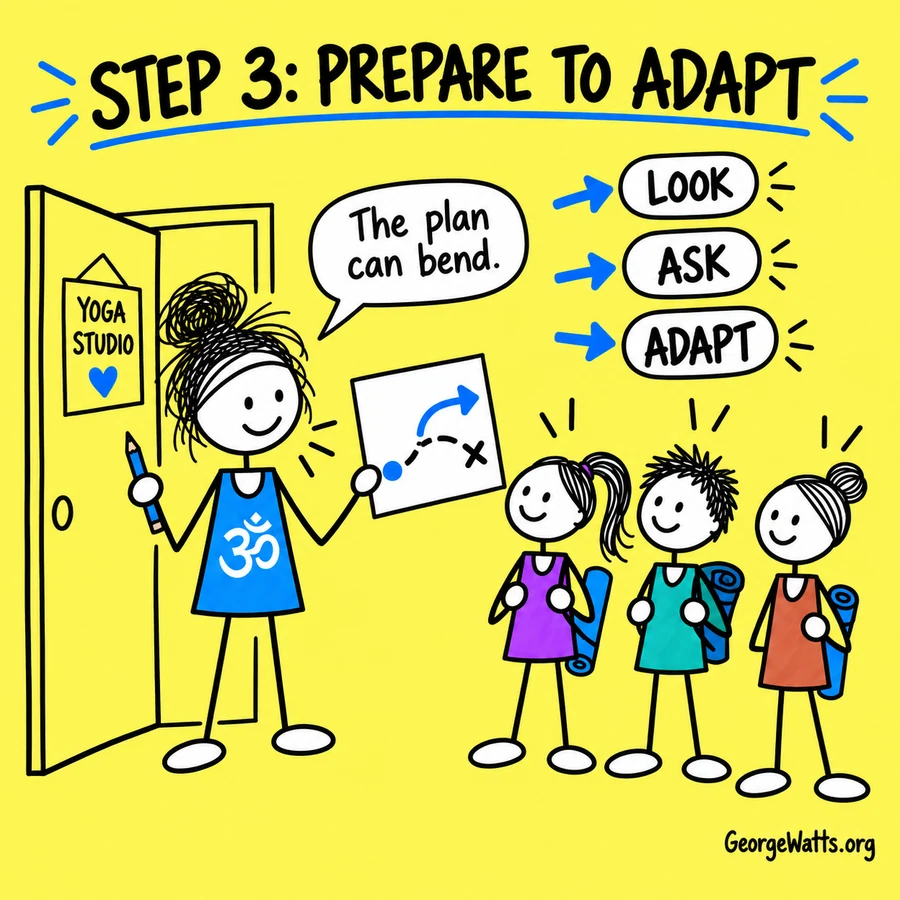
Before class, I look at the room, greet students and listen. A smaller group, a colder hall, missing props or someone who needs a different route can change what is sensible.
Imagine this: you planned for ten regular students, but four people arrive, two are new, the hall is cold and only three chairs are available. The purpose can stay the same, but the route should change.
Notice the room, equipment, energy and how students are moving today.
Example: Two students place chairs beside them and the group is moving cautiously after coming in from the cold.
Invite relevant information without diagnosing or promising a treatment.
Example: Ask: “Would you prefer to explore this seated, standing with support or using a mixture today?”
Change range, pace, support, repetition or timing while keeping the purpose clear.
Example: Replace free-standing Warrior III with both hands on a chair and shorten the balance holds.
Prepare options before they are urgent
For Tree Pose, the supported version might use one hand on a chair. The smaller version might keep the toes of the lifted foot on the floor. The clear way to stop is to return both feet to Mountain Pose. If time runs short, I can omit the second round instead of stealing five minutes from Savasana.
Preparation does not replace appropriate training, assessment or referral. For example, if a student asks which pose will treat persistent knee pain, I do not diagnose the problem or prescribe a cure. I offer comfortable participation choices within my training and suggest that they seek appropriate individual advice.
What I bring into the room
- a short teaching copy of the plan;
- any props the class genuinely needs;
- a pen for notes after class;
- a watch or quiet timer;
- curiosity about the people in front of me.
A small practical example: if my plan says “six chairs at the wall before class,” I can set them out early. That is much calmer than discovering halfway through Warrior III that the chairs are still enjoying retirement in the store cupboard.
The Five-Minute Version
Choose three anchors. When preparation time is tight, clarity matters more than detail.
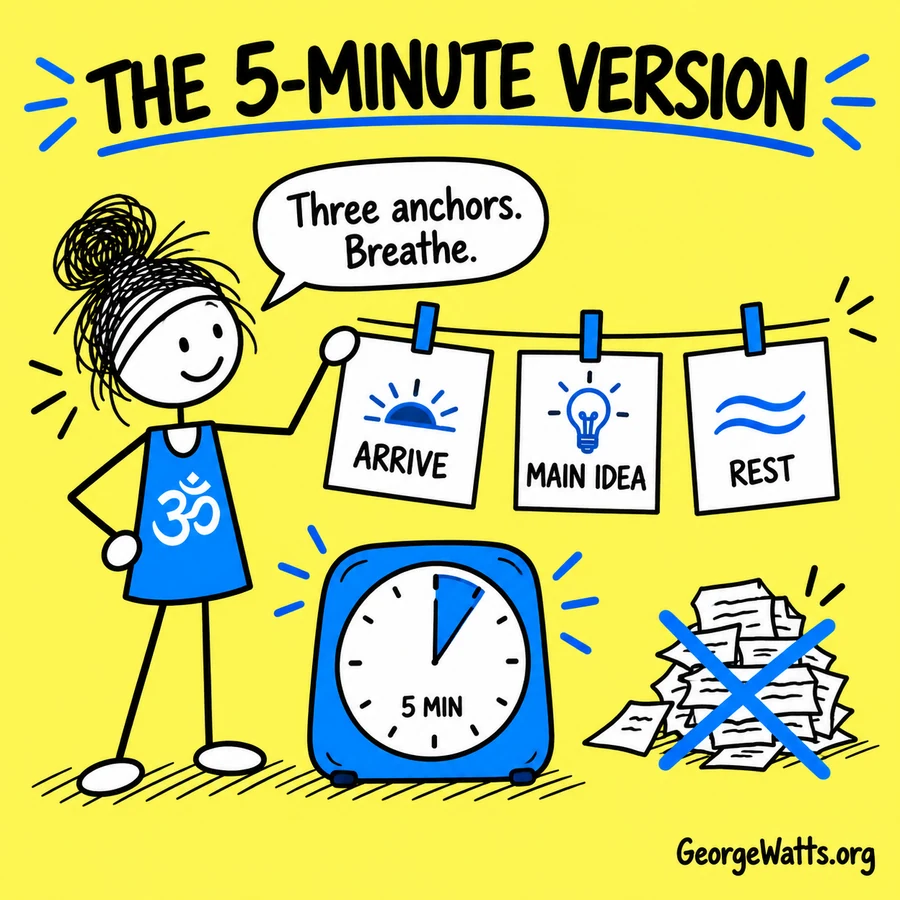
- 1Arrive
Choose one simple way for the group to settle and meet the class idea.
Example: Stand in Mountain Pose and slowly shift the weight from left to right, noticing the base of support.
- 2Main idea
Choose one exploration and two or three activities that genuinely prepare for it.
Example: Explore steady balance with heel raises, Warrior III at the wall and supported Tree Pose.
- 3Rest
Choose how you will reduce demand and protect time for a comfortable ending.
Example: Return to Mountain, take a supported forward fold and finish with five minutes in Savasana.
Add one easier or better-supported alternative. For example, offer Tree Pose with one hand resting on a chair. Then decide which activity you will leave out if the class runs short. Take a breath. A short, coherent plan is usually safer and more teachable than a crowded plan assembled in a hurry.
Four More Plans You Can Sketch in Five Minutes
These are class skeletons. They are examples of plans you can create in five minutes, not classes that last five minutes. Each one still needs suitable timings, options and teaching detail for your group.
Hip mobility class. Arrive: Begin in constructive rest and slowly move the knees from side to side. Main idea: Explore comfortable hip movement with Cat-Cow, a padded Low Lunge and Supine Figure Four. Rest: Return to constructive rest, then settle into Savasana.
Chair yoga class. Arrive: Sit with both feet supported and notice the contact with the chair and floor. Main idea: Explore spinal movement with seated Cat-Cow, shoulder circles and supported side bends. Rest: Place the hands on the thighs, return to natural breathing and finish with a short seated relaxation.
Gentle backbend class. Arrive: Lie in constructive rest and notice the natural movement of the breath. Main idea: Explore extension gradually with pelvic tilts, a low Bridge Pose and Sphinx Pose. Rest: Hug the knees comfortably, take a gentle supine twist and finish in Savasana.
Breath-led movement class. Arrive: Sit comfortably and observe the breath without trying to change it. Main idea: Coordinate easy arm raises and folds with the breath, then explore slow Half Sun Salutations. Rest: Come down to the floor, let the breath return to its own rhythm and finish with a comfortable rest.
Should I memorise the whole yoga class?
No. Know the purpose, the three anchors and the next useful decision. For a balance class, I might remember “Mountain, Tree, Savasana” and glance at my page for the exact warm-up and transitions. I do not need to store every pose and sentence in my head.
How far ahead should I prepare?
I prefer to make the plan early enough to revisit it once. For example, I might prepare my familiar Tuesday evening class on Monday, then look at it again before leaving home. For a new Saturday chair-yoga workshop, I might build the plan on Wednesday and rehearse the unfamiliar transitions on Friday.
What if I change the plan while teaching?
Good. Imagine that eight experienced students were expected, but three beginners arrive. You might remove a complicated balance transition, bring chairs to the wall and spend longer teaching the first version. The purpose remains “explore steady balance,” but the route now fits the actual class.
Prepare With the Online Yoga Lesson Planner
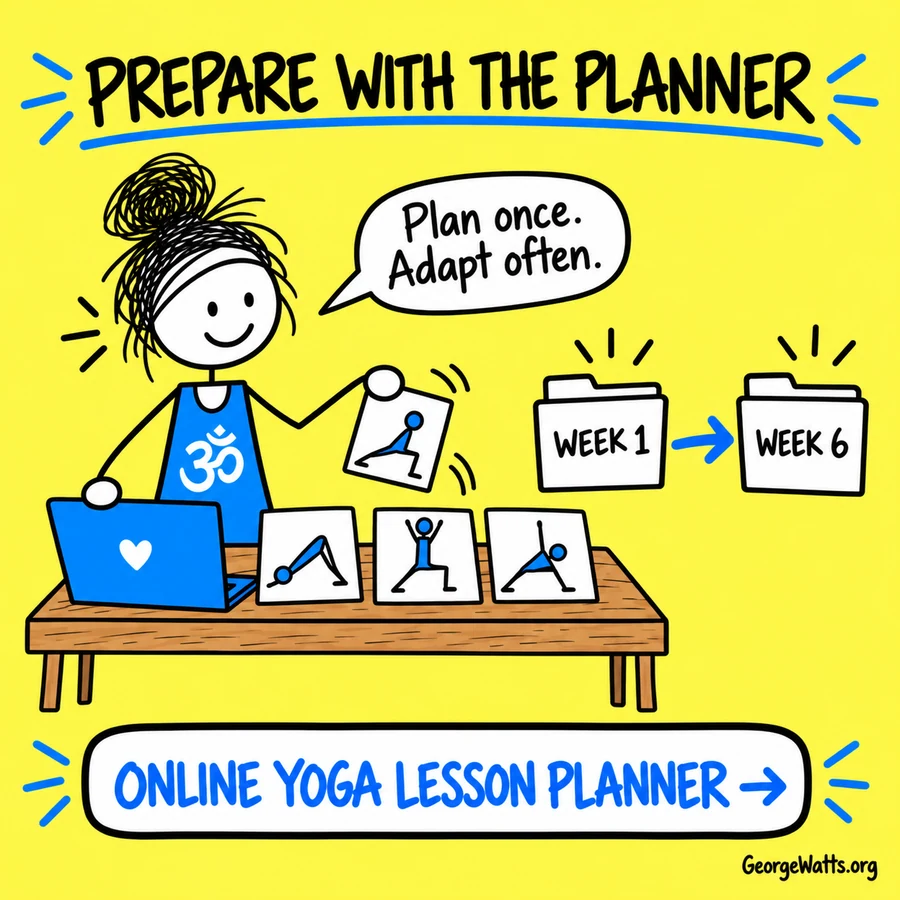
Give the routine one home. The Online Yoga Lesson Planner lets you choose from thousands of poses, easily arrange sequences, and copy completed lesson plans to quickly create a 6 or 10 week course.
You can keep a detailed version for preparation and a compact version for teaching, then save what worked and improve it for the next class.
For example: copy last Tuesday’s balance plan, keep its arrival and ending, replace the three central balance activities with hip-mobility activities, then save the new version as Week 2. You begin with a tested structure instead of another blank page.
George’s Conclusion
Good preparation creates attention. Build a clear plan, rehearse the parts that need testing and enter the room ready to adapt.
The aim is not to perform the paper perfectly. It is to spend less energy remembering what comes next and more energy noticing what your students need now.
If the page says unsupported Tree Pose but the room tells you “chairs today,” using the chairs is not abandoning the plan. It is the moment the plan becomes teaching.