
| Membership Category: | Pilates Lesson Planner |
|---|---|
| Sub Category: | Reformer |
| Types: | Standing |
| Anatomy: | Hips, Psoas, Hamstrings |
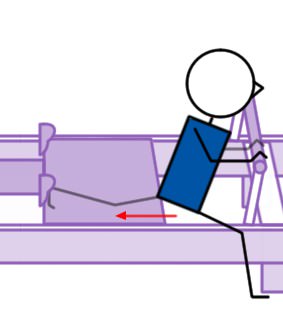
Stand beside the Reformer, placing left knee on carriage and left foot near shoulder rest. Keep right foot on the floor. Square hips, hands on footbar. Exhale, press left leg back, lunge right knee forward, then return to start.
Enhances hip mobility. Improves flexibility. Strengthens legs.
Beginner: Use a lighter spring for less resistance. Intermediate: Add a slight forward bend to increase stretch. Advanced: Increase the range of motion with deeper lunge.
Keep hips squared and knees aligned to avoid strain.
Click here for lots of FREE downloadable Yoga lesson plans.
Click here for lots of FREE downloadable Pilates lesson plans.
- Annalisa
- opt
- Reformer Exercises
- V1 Mixed Level
- flow 1.5
- flow 1.5
- Reformer Exercises
- Julie
- Introduction Reformer
- Reformer Beginner
- 90 mins Reformer Exercises
- Alan and Hilary - 23 November
- Alan and Hilary - 23 November
- Reformer
- Rhian - 25 January 2020
- Anna - 1 Feb 2020
- Reformer Exercises
- Reformer
- Sue and Mike - 22 February
- Sue and Mike - 22 Feb 2020
- Maya - 14 November 2020
- CP Reformer Flow 1
- Reformer Exercises
- Demo 2
- Reformer Exercises
- CP Reformer Flow 1-shared
- Beginners reformer
- Beginners reformer
- Beginners reformer2
- CP Reformer Flow 1-saturday
- Beginners reformer2
- Beginners reformer2
- Beginners reformer2
- Beginners Reformer Footwork-->Straps Arms+Legs
- Beginners Reformer Footwork-->Straps Arms+Legs
- Beginners Reformer Footwork-->Straps Arms+Legs
- Beginners Reformer Footwork-->Straps Arms+Legs
- Apprentice Test Out
- Apprentice Test Out
- Beginners Reformer Footwork-->Straps Arms+Legs
- Beginners Reformer Footwork-->Straps Arms+Legs
- Beginner Reformer Footwork - Straps - Short Spine
- Beginner Reformer Footwork - Straps - Short Spine
- CP Reformer Flow 1-saturday
- CP Reformer Flow 1-saturday
- Pilates K
- Pilates K
- CP Reformer Flow 1-CF
- CP Reformer Flow 1 Beginner
- flow 1.5
- flow 1.5
- CP Reformer Flow 1-CF
- CP Reformer Flow 1 CF2
- reformer beginner side lying 1
- CP Flow 1.5
- CP Flow 1.5
- CP Reformer Flow 1-saturday
- Flow 1-B
- Flow 1-A
- Flow 1-A
- Flow 1-B
- Beginners reformer2
- Reformer Exercises
- Beginners Reformer
- Beginners Reformer
- CP Reformer Flow 1-CF
- Flow 1-A
- Beginners Reformer Footwork-->Straps Arms+Legs
- Beginners Reformer Footwork-->Straps Arms+Legs
- Beginners Reformer
- Beginners Reformer
- reformer beginner side lying 1
- Haw Cheng
- Beginners reformer2
- Reformer
- 90 mins Reformer Exercises
- Reformer Exercises
- Beginners reformer2
- Reformer - Cardio 1Spring Footbar Up
- Reformer class plan - 60min
- Beginners reformer2
- CP Reformer Flow 1-shared
- CP Reformer Flow 1-CF
- Beginners reformer2
- CP Reformer Flow 1-CF
- CP Reformer Flow 1 CF2
- Beginner Reformer Footwork - Straps - Short Spine
- Beginner Reformer Footwork - Straps - Short Spine
- CP Reformer Flow 1-shared
- Reformer Exercises
- Beginners Reformer Footwork-->Straps Arms+Legs
- Beginners Reformer Footwork-->Straps Arms+Legs
- CP Reformer Flow 1-CD
- CP Reformer Flow 1-CD-2
- Flow 1-A
- CP Reformer Flow 1-CD-2
- Reformer Exercises 1
- Reformer Exercises
- CP Reformer Flow 1-CD-2
- Flow 1-A
Scooter Stretch on Reformer: 30 Modifications for All Levels
[br]
The Scooter Stretch on Reformer is a dynamic, lower body stretch that engages the hamstrings, glutes, and hip flexors while also challenging balance and coordination. It is an excellent exercise for increasing flexibility, strengthening the legs, and improving the overall mobility of the hips and pelvis. Found in the "Intermediate" category of the Reformer Pilates Expansion Card Deck, (an add-on deck for the Reformer Pilates Card Deck) this exercise is designed for those with a solid foundation in Pilates, particularly those seeking to enhance their range of motion and improve stability.
[br]
Scooter Stretch on Reformer Exercise Steps
[br]
Stand beside the Reformer, placing the left knee on the carriage and positioning the left foot near the shoulder rest.
Keep the right foot flat on the floor with the right knee bent.
Square the hips, ensuring they are aligned and facing forward.
Place both hands on the footbar for support.
Exhale as you press the left leg back, extending the left leg behind you while lunging the right knee forward.
Inhale as you return to the starting position, bringing the right knee back and releasing the stretch.
Repeat on the other side for balance and symmetry.
The Scooter Stretch on Reformer is an accessible but challenging exercise, and with proper modifications, it can be adapted for various skill levels. Below are 30 modifications—divided into beginner, intermediate, and advanced categories—to help practitioners tailor the exercise to their needs.
[br]
10 Beginner Modifications For Scooter Stretch on Reformer
[br]
Beginner Modification 1: Reduce the Resistance
Start with a lighter spring setting to decrease resistance. This will allow you to perform the movement with less strain and better control.
Beginner Modification 2: Use a Block for Support
Place a small block under your front foot for additional stability, helping maintain proper alignment in the hips and knees while improving balance.
Beginner Modification 3: Keep the Knees Higher
Instead of sinking the knee towards the carriage, keep the knees higher as you lunge forward. This will reduce the range of motion and make the movement less intense.
Beginner Modification 4: Perform One Leg at a Time
Rather than alternating legs, work on one leg at a time. This can help you develop strength and coordination before moving to alternating.
Beginner Modification 5: Hold a Wall for Stability
Stand with your back against the wall or hold onto a nearby support to improve balance and reduce the risk of wobbling during the exercise.
Beginner Modification 6: Shorten the Range of Motion
Do not press the carriage too far back. Shorten your range of motion and focus on proper form and alignment.
Beginner Modification 7: Slow Down the Movement
Perform the exercise slowly, focusing on control as you press the leg back and bring it forward. This allows for better engagement of the muscles and improved coordination.
Beginner Modification 8: Keep the Core Engaged
Maintain a strong core throughout the exercise. Focus on pulling the belly button towards the spine to engage the abs, which will support your balance.
Beginner Modification 9: Add a Breathing Cue
Include breathing cues such as “exhale as you press back, inhale as you return.” This can help beginners understand the rhythm of the movement and maintain fluidity.
Beginner Modification 10: Perform Without the Carriage Movement
Practice the same movements without moving the carriage first. This helps to build strength and improve the mind-body connection before adding the dynamic element.
[br]
10 Intermediate Modifications For Scooter Stretch on Reformer
[br]
Intermediate Modification 1: Increase the Resistance
Switch to a medium resistance spring setting to increase the difficulty level. This will challenge your leg strength and engage the muscles more effectively.
Intermediate Modification 2: Add More Range of Motion
Increase the range of motion by pressing the carriage further back while maintaining control. This allows you to work deeper into the hip flexors and hamstrings.
Intermediate Modification 3: Focus on Hip Alignment
Ensure the hips stay square and aligned throughout the movement. Pay attention to the pelvis’s position to prevent overextension or misalignment.
Intermediate Modification 4: Include a Pause at the End of Each Rep
Pause briefly at the full extension of the movement to increase time under tension, helping to build strength in the glutes and hamstrings.
Intermediate Modification 5: Perform Alternating Legs
Once you are comfortable with each leg, begin to alternate between the left and right leg. This will help improve coordination and balance.
Intermediate Modification 6: Include a Forward Reach
When extending your leg back, add an upper body stretch by reaching your arms forward. This adds a challenge for the upper body and requires increased core stability.
Intermediate Modification 7: Add a Pulse at the End of the Movement
At the end of the carriage press, pulse gently for a few repetitions to deepen the stretch and engage the muscles more intensely.
Intermediate Modification 8: Focus on Stability with the Hands
Maintain firm control over the footbar with your hands to keep the upper body engaged and stabilise the movement.
Intermediate Modification 9: Perform the Movement on a Higher Spring Setting
Use a stronger spring for a more challenging resistance. This modification will require more muscle engagement, particularly in the glutes and quads.
Intermediate Modification 10: Experiment with Tempo
Try performing the movement in a slower tempo, pausing briefly when the carriage is extended before returning to start. This increases time under tension and strengthens muscles.
[br]
10 Advanced Modifications For Scooter Stretch on Reformer
[br]
Advanced Modification 1: Increase the Speed
Perform the Scooter Stretch at a quicker pace for a more dynamic and fluid movement. This increases the cardiovascular intensity and engages more muscle groups simultaneously.
Advanced Modification 2: Add a Knee Lift
After pressing the carriage back, add a knee lift at the top of the lunge. This will challenge your core stability and balance further.
Advanced Modification 3: Combine with a Split Squat
Combine the Scooter Stretch with a split squat movement. After pressing the carriage back, perform a split squat on the right leg to increase the challenge.
Advanced Modification 4: Incorporate a Jump
Add a small jump at the bottom of the lunge to incorporate plyometric movement. This modification will increase strength and explosive power in the legs.
Advanced Modification 5: Use Single-Legged Scooter Stretch
Perform the exercise with one leg on the carriage and the other leg extended. This increases the challenge for balance and engages the stabiliser muscles.
Advanced Modification 6: Incorporate a Pulse in the Lunge
Once you reach the bottom of the lunge, perform a quick pulse by bending and straightening the front knee several times. This adds intensity and muscle engagement.
Advanced Modification 7: Add a Reach Behind You
At the top of the movement, reach your arms behind you, stretching through the chest and shoulders as you press the carriage back. This increases the stretch and engages the upper body.
Advanced Modification 8: Increase the Resistance Further
Use a high resistance spring to make the movement more challenging. This increases the intensity of the muscle engagement in the lower body.
Advanced Modification 9: Perform the Exercise on a Bosu Ball
Place the footbar or your hands on a Bosu ball for an added balance challenge. This works the stabiliser muscles and improves overall coordination.
Advanced Modification 10: Use Resistance Bands for Upper Body Engagement
Attach resistance bands to the carriage or footbar for extra resistance in the arms. This will add a total-body challenge to the exercise, engaging both the legs and the arms.
[br]
George’s Conclusion And the Reformer Pilates Card Deck
[br]
The Scooter Stretch on Reformer is an excellent exercise for developing strength, flexibility, and balance. It targets several major muscle groups, including the hamstrings, glutes, and hip flexors, and helps to increase hip mobility while improving overall body awareness.
As part of the Reformer Pilates Expansion Card Deck, this exercise is a great addition to your Pilates repertoire, offering a challenge for intermediate practitioners looking to deepen their practice. For those who are just starting or want to increase the intensity, the various modifications ensure that this exercise can be tailored to suit your needs, no matter your level.
If you're looking for more exercises to challenge yourself, or to find the right level of difficulty, the Reformer Pilates Card Deck and the Reformer Pilates Expansion Card Deck are excellent resources. These decks not only offer a variety of exercises but also provide clear, concise instructions that can be used at home or in the studio.
Video Of Pose
Follow Up Poses
Yoga and Pilates lesson planning made easy