
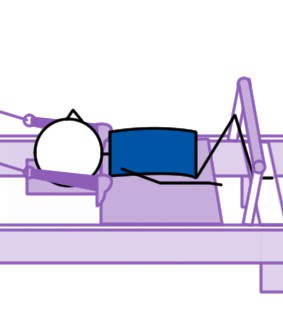
Pelvic Tilt Reformer II
| Category: | Reformer |
|---|---|
| Share on: |
|


 Yoga Lesson Planner
 Pilates Lesson Planner
| Category: | Pilates Lesson Planner |
|---|---|
| Sub Category: | Reformer |
| Types: | Seated & Floor, Stretch, Supine |
| Anatomy: | Core |
| Chakras: | Heart Centre, Sacral Centre, Solar Plexus Centre |
| Therapy: | Back Pain, Poor Posture |
| Drishti: | Up |
| Dosha: | Kapha, Pitta |
Part I: Running on your back. Part II: Using your stomach muscles, lift both feet up and place them gently on the arches with toes slightly turned out. Heels are under the bar. Arches around the top of the bar. Press arms down. Lift pelvis up (fist distance). Push off with your feet and return to the start (without changing that "fist" distance). Make sure your feet stay still during the movement. Repeat.
Strengthens lower back, core, glutes, and legs. improves spinal stability and posture.
Beginner: Perform with feet flat on the mat. Intermediate: Use lighter resistance for controlled movement. Advanced: Add a one-legged variation for increased intensity.
Neck, back, or hip pain.
Click here for lots of FREE downloadable Yoga lesson plans.
Click here for lots of FREE downloadable Pilates lesson plans.
- Reformer 1
- Club Pilates - Reformer Postures
- Week 1 Pilates
- Basic Reformer
- 10-15 Minute Flow
- Aidan Murphy
- reformer icons
- reformer icons
- Pilates Essentials
- Pilates Essentials: FW & Bridge
- All Reformer Excersises
- All Reformer Exercises
- Pilates Reformer Test (Spike)
- Reformer Exercises
- Flow 1.5 ideas - delete
- All Reformer Excersises
- workshop flow
- 45 MINUTE – REFORMER FLOW FULL BODY
- Reformer 60 min
- 45 MINUTE – REFORMER FLOW FULL BODY
- Ask Genie 1
- Reformer 60 min
- Lesson 5
Pelvic Tilt On Reformer II: A Comprehensive Guide to 30 Modifications
The Pelvic Tilt On Reformer II is a fundamental exercise in Reformer Pilates, designed to help strengthen the core, increase flexibility in the spine, and enhance overall body control.
This exercise is included in the Reformer Pilates Expansion Card Deck, which is an extension of the original Reformer Pilates Card Deck.
The Pelvic Tilt is a foundational movement that can be tailored to suit a wide range of abilities, from beginners to advanced practitioners. It is located within the “Foundation” category of the Reformer Pilates Expansion Card Deck, making it especially suitable for beginners who are looking to build a solid Pilates foundation.
The Pelvic Tilt exercise primarily focuses on engaging the core muscles, particularly the abdominals, and promoting spinal mobility. It is excellent for improving posture and alleviating tension in the lower back. While this movement can be simple in its basic form, it is also highly adaptable, allowing for numerous modifications to cater to individuals at different skill levels.
In this blog post, we’ll explore 30 different modifications of the Pelvic Tilt Reformer II exercise, with 10 variations each for beginners, intermediates, and advanced practitioners. These modifications will help you progress safely while building strength, flexibility, and stability.
Let’s dive in!
10 Beginner Modifications For Pelvic Tilt On Reformer II
Beginner Modification 1: Pelvic Tilt with Cushion Support
For beginners, adding a cushion under the head or lower back can provide additional support and comfort during the exercise, helping you focus on mastering the movement without straining.
Beginner Modification 2: Pelvic Tilt with Feet on a Soft Surface
Perform the pelvic tilt with your feet placed on a soft surface such as a thick mat or foam pad. This modification can reduce the intensity of the exercise, making it more accessible for those who are new to Reformer Pilates.
Beginner Modification 3: Pelvic Tilt with Legs Bent Less
Start with a gentle pelvic tilt and keep the legs bent at a less extreme angle. This can help reduce the range of motion required and make the exercise more comfortable for beginners.
Beginner Modification 4: Pelvic Tilt with Feet Close Together
Keeping the feet closer together reduces the activation of the outer leg muscles, allowing beginners to focus more on the pelvic movement and less on the stabilisation of the legs.
Beginner Modification 5: Pelvic Tilt with Support from a Pilates Circle
Place a Pilates circle between the thighs to gently squeeze as you perform the pelvic tilt. This can help engage the inner thighs and offer additional stability without overloading the core.
Beginner Modification 6: Pelvic Tilt with Gentle Breathing
Focus on deep, slow breathing throughout the movement. Exhaling as you tilt your pelvis and inhaling as you return to the starting position ensures that the core is properly engaged without excessive strain.
Beginner Modification 7: Pelvic Tilt with Shorter Hold Time
Hold each tilt for a shorter period of time, such as one or two breaths. This modification helps prevent fatigue and allows beginners to get used to the motion before extending the hold time.
Beginner Modification 8: Pelvic Tilt with a Lower Reformer Position
Set the Reformer to a lower resistance or spring setting to make the movement easier. This allows beginners to perform the pelvic tilt with less resistance while still engaging the core muscles.
Beginner Modification 9: Pelvic Tilt with Neutral Spine Position
Rather than focusing on a pronounced arch in the lower back, maintain a more neutral spine position during the tilt. This modification will help beginners get used to the pelvic movement without excessive spinal extension.
Beginner Modification 10: Pelvic Tilt with Arm Position Variation
Start with your arms resting comfortably by your sides, palms facing down. This position provides stability and helps beginners focus on the pelvis movement rather than balancing.
10 Intermediate Modifications For Pelvic Tilt On Reformer II
Intermediate Modification 1: Pelvic Tilt with Reformer Resistance
Increase the resistance on the Reformer by adjusting the springs to a moderate level. This modification will challenge the core and promote greater strength, making it suitable for intermediate practitioners.
Intermediate Modification 2: Pelvic Tilt with One Leg Lifted
Incorporate a one-legged variation by lifting one leg while performing the pelvic tilt. Alternate legs with each repetition. This adds an additional level of challenge to the movement, requiring increased core stability.
Intermediate Modification 3: Pelvic Tilt with Feet on the Footbar
Position your feet on the footbar rather than the mat. This modification elevates the exercise, increasing the challenge to the core and engaging the lower body muscles more effectively.
Intermediate Modification 4: Pelvic Tilt with Arms Raised
As you tilt the pelvis, raise your arms towards the ceiling or overhead. This increases the engagement of the abdominal muscles, promoting core strength and enhancing coordination.
Intermediate Modification 5: Pelvic Tilt with Controlled Movements
Focus on a slower, more controlled movement. Inhale and exhale at a steady pace, making sure each tilt is deliberate. This will help improve muscle awareness and the overall quality of the exercise.
Intermediate Modification 6: Pelvic Tilt with Feet in Parallel
Perform the pelvic tilt with the feet placed in parallel rather than with toes pointed or feet rotated outward. This variation challenges the legs and engages the inner thigh muscles more directly.
Intermediate Modification 7: Pelvic Tilt with Heel Digging
Dig your heels into the mat as you perform the pelvic tilt. This modification engages the posterior chain muscles, including the glutes and hamstrings, while still targeting the core.
Intermediate Modification 8: Pelvic Tilt with an Extended Hold
Hold the pelvic tilt position for a few breaths longer, aiming to sustain the contraction in the core. This modification improves endurance and strengthens the abdominal muscles over time.
Intermediate Modification 9: Pelvic Tilt with Knee Tucks
After performing the pelvic tilt, add a knee tuck by bringing one knee towards the chest while maintaining the pelvic tilt position. Alternate between legs to engage both the core and hip flexors.
Intermediate Modification 10: Pelvic Tilt with Reformer Springs at Varying Tensions
Use varying tensions on the Reformer springs to add an extra challenge. Adjust the springs for different levels of resistance, and alternate between lighter and heavier settings during your practice.
10 Advanced Modifications For Pelvic Tilt On Reformer II
Advanced Modification 1: Pelvic Tilt with Feet on a Stability Ball
Place your feet on a stability ball instead of the Reformer mat. This requires more balance and engages the core muscles to stabilise the body while performing the pelvic tilt.
Advanced Modification 2: Pelvic Tilt with Extended Leg Movement
While performing the pelvic tilt, extend one leg straight out in front of you. This advanced variation engages the core and hip flexors more deeply while challenging the stability of the pelvis.
Advanced Modification 3: Pelvic Tilt with Footbar Overhead
Position your feet on the footbar, and extend your arms overhead or behind your head. This adds intensity to the movement by increasing the stretch in the back and intensifying the core engagement.
Advanced Modification 4: Pelvic Tilt with Dynamic Movement
Perform the pelvic tilt with dynamic movement by flowing between tilting and releasing the pelvis rapidly. This modification incorporates more cardiovascular effort while maintaining control of the core.
Advanced Modification 5: Pelvic Tilt with One Arm Reaching
Incorporate an arm reach as you tilt the pelvis. Reach one arm overhead or out to the side while maintaining the pelvic tilt position, further challenging core stability and balance.
Advanced Modification 6: Pelvic Tilt with Floating Legs
Lift both legs off the Reformer as you perform the pelvic tilt. This advanced variation requires tremendous core strength to stabilise the body while keeping the legs in the air.
Advanced Modification 7: Pelvic Tilt with Added Resistance Band
Add a resistance band around the thighs or calves while performing the pelvic tilt. This increases the tension in the legs and core, helping you build strength and muscle control.
Advanced Modification 8: Pelvic Tilt with Hip Extension
After tilting the pelvis, extend one leg at the hip level, creating a straight line from the foot to the head. This adds extra resistance and engages the glutes, quads, and core even more intensely.
Advanced Modification 9: Pelvic Tilt with Head Off the Reformer
Perform the pelvic tilt while lifting the head and shoulders slightly off the Reformer. This increases the challenge for the abdominal muscles, particularly the upper abdominals.
Advanced Modification 10: Pelvic Tilt with Jumping Movements
Add a slight jump or controlled bounce to the pelvic tilt, where you engage the pelvic floor muscles and add a cardiovascular component to the exercise.
George’s Conclusion and the Reformer Pilates Card Deck
The Pelvic Tilt On Reformer II is a versatile exercise that can be modified for every skill level. Whether you are a beginner looking for a supportive and accessible version or an advanced practitioner seeking a more intense challenge, there is a modification to suit your needs.
If you enjoyed these modifications, you’ll love the Reformer Pilates Card Deck and the Reformer Pilates Expansion Card Deck. These comprehensive card decks provide you with a wide variety of exercises, from foundational movements like the Pelvic Tilt to more advanced variations, helping you progress steadily in your practice.


