

George’s Intro
I updated this post in 2026.
A useful VIP card should feel like a thank-you, not a tiny laminated hostage situation.
A simple card can reward regular attendance, introduce students to a good local business or create a natural moment for conversation. The important part is choosing one clear purpose and making the rules easy to understand.
I’m George, a BWY yoga teacher, creator of the Online Yoga Lesson Planner, yoga card deck maker and enthusiastic sticky-note doodler.
When I used a stamped loyalty card, I found that students enjoyed bringing it to be signed. It also gave quieter students a simple reason to approach me after class. That brief conversation was useful in itself, quite apart from the eventual reward.
Jump to the Editable Yoga VIP Card Pack ↓

What Is a Yoga VIP Card?
A Yoga VIP Card is a simple physical or digital card that gives regular students a clearly defined benefit. It can work in two different ways.
Partner-Perks Card
A local café, bookshop, therapist or other suitable business offers a modest benefit to cardholders. The arrangement introduces your students to the business and gives the partner a reason to mention your classes.
Attendance Loyalty Card
You stamp or initial the card after an eligible visit. Once the agreed number of spaces is complete, the student receives the stated reward—perhaps a guest pass, small class credit or workshop saving.
You do not need both models. One modest, well-explained benefit is better than a crowded card containing fifteen offers nobody can remember.
8 Steps To Create A Yoga VIP Card
Reward loyalty without quietly losing your margin.
The first four steps choose the purpose, card model, affordable reward and rules. Steps five to eight find a partner, design the card, introduce it clearly and test it for 30 days.
Choose the Card’s Purpose

Start with one job.
Decide what the card is meant to support before choosing colours, stamps or rewards. It might recognise regular attendance, make a class pack easier to explain, encourage students to try a second suitable class or support a relationship with a nearby business.
- Who is the card for?
- What action qualifies?
- What benefit will they receive?
- Why is that useful to the student?
A card designed merely to “make people loyal” is too vague. A card that thanks current students after ten eligible visits is specific enough to test.
Pick One Simple Card Model

Choose simplicity over sparkle.
Option A: Partner Perks
Offer one clearly stated benefit from one relevant local business. A café near the venue, an independent bookshop or a complementary practitioner may be a sensible fit when the relationship is genuine and the offer is appropriate.
Option B: Attendance Reward
Mark one space after each qualifying visit. When the card is complete, provide the promised reward. Keep the reward modest enough that the scheme remains comfortable if more students use it than expected.
My older discount article listed several ideas at once: concessions, bring-a-friend pricing, savings for attending two classes and a class-pack reward. Those remain possible tests, but do not launch all of them together. Pick one and learn from it.
One card. One promise.If the explanation needs a flowchart, the card has started teaching its own advanced class.
Protect Your Margin

Cost the reward first.
Write down your normal price, venue cost, payment fees, preparation time and any other relevant expense. Then calculate the maximum cost of the reward if every eligible student claims it.
- Use a fixed benefit rather than an open-ended promise
- Set a clear validity period
- Decide whether offers can be combined
- Include existing class-pass holders in your calculation
- Avoid a discount that makes the class feel disposable
- Check whether the admin is worth the benefit
A non-price benefit may fit better: early notice of a workshop, a guest pass with conditions, a useful handout or a small partner perk. The reward should never depend on an inflated “usual” price or misleading urgency.
Write the Rules in Plain English

Remove the awkward questions.
State who receives the card, what earns a stamp, what the completed card provides, when it expires and what happens if it is lost. If a partner supplies the benefit, name the participating location and any genuine exclusions.
Example Attendance-Card Wording
Bring this card to an eligible weekly class. I’ll add one stamp after each paid visit. Complete ten stamps by [date] and receive [specific reward]. One card per student. The card has no cash value and cannot be combined with another offer.
Change the wording to match your actual scheme. Do not copy conditions that you are unwilling or unable to apply consistently.
Approach One Suitable Local Partner

Make a small, fair proposal.
Choose a business your students might genuinely value. Explain the approximate group, the proposed benefit and how long you want to test it. Do not promise a flood of customers or imply that every student will participate.
Simple Partner Message
Hello [Name]. I teach a weekly yoga class nearby for approximately [number] students. I’m testing a simple VIP card for regular attendees and wondered whether a modest cardholder benefit at [business] might be useful to both groups. I could mention the offer accurately to my students, and you could decide whether you want to display my class details. Would you be open to discussing a 30-day pilot with clear terms?
A partner may prefer a fixed perk to a percentage discount. Ask what is workable for them, confirm everything in writing and make it easy for either side to stop after the pilot.
For more partnership guidance, see my Yoga Referral Marketing guide.
Design a Card People Can Use
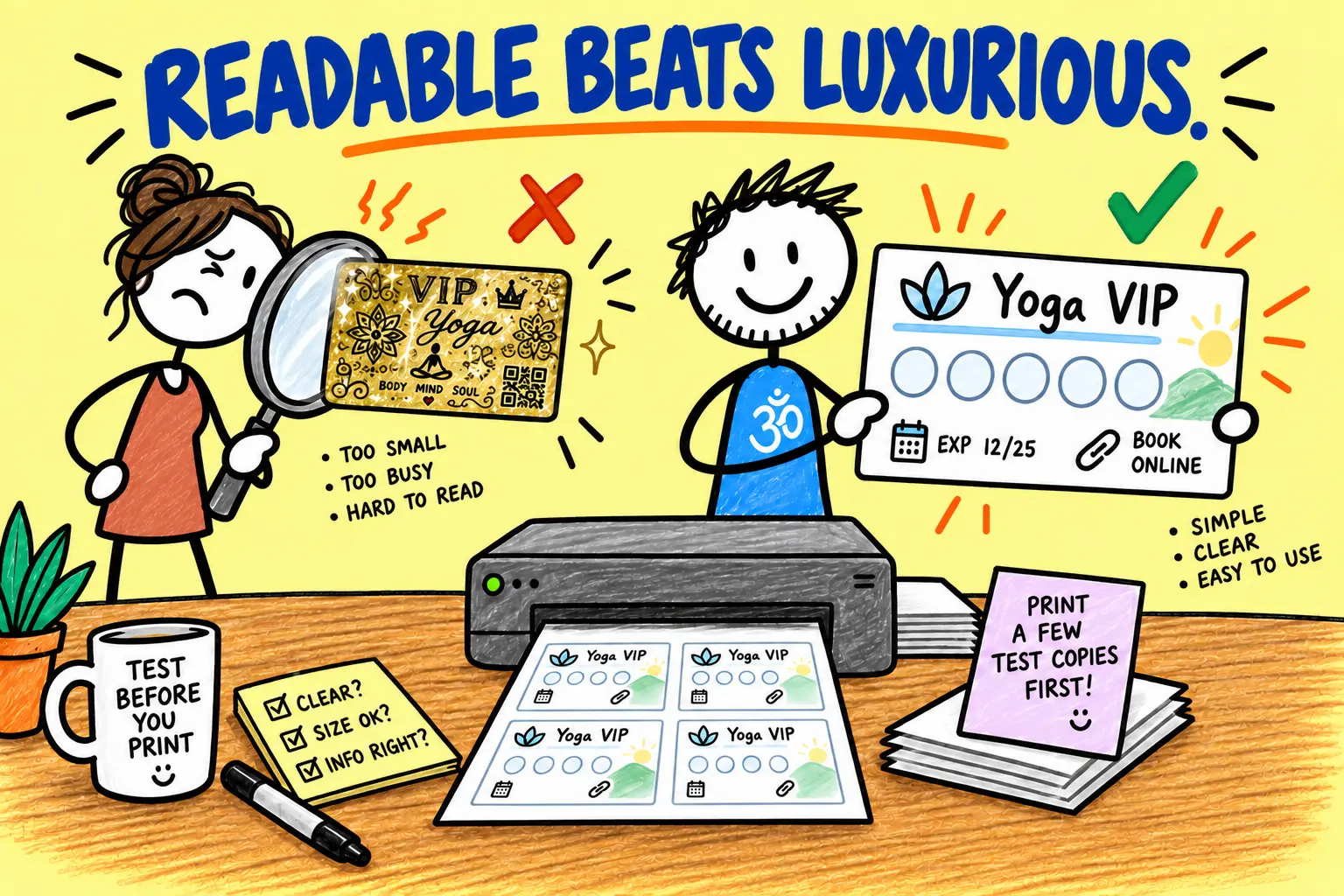
Readable beats luxurious.
A standard business-card size is convenient, but a digital version can also work if you have a dependable way to record progress. You do not need a particular printing company, metallic finish or platform.
- Your yoga business or teacher name
- The words “VIP Card” or “Loyalty Card”
- The exact benefit
- Qualifying action or stamp spaces
- Expiry date
- Short conditions
- Website or booking link
- Partner name, if applicable
Print a small quantity first. Check the card in ordinary lighting and ask one person to explain the offer back to you. If they cannot, revise the wording before ordering more.
Yoga VIP Card Canva Pack
Choose an attendance card or a partner-perks card, then edit the wording for your own yoga business.

What Is Included
- Attendance-card fronts and 10-stamp backs
- Partner-perks fronts and benefit-detail backs
- Eight cards per A4 sheet
- A built-in printing guide
Protect the master: Canva opens the view-only design in a new browser window. Use Canva’s make-a-copy option before changing the text.
How to Print the Front and Back
- Open the Canva design and make your own copy.
- Choose the attendance set (pages 1–2) or partner-perks set (pages 3–4), then edit every repeated card.
- Select Share → Download → PDF Print and download only the matching two pages.
- Print double-sided at 100% or Actual size, using Flip on long edge.
- Test on ordinary paper first. Hold the sheet to the light to check the fronts and backs align.
- When the test is right, print on 200–250 gsm card if your printer supports it, then cut around the outer card borders.
Manual duplex printer? Print the front page, return the sheet to the paper tray in the direction shown by your printer, and print the matching back page. Mark one corner of the test sheet so you can see how your printer turns the paper.
Introduce the Card Without Pressure

Offer it as a thank-you.
Explain the scheme briefly at the end of class, include the terms in a follow-up email or place them on the booking page. Participation should be optional, and students who ignore the card should receive exactly the same welcome and teaching.
Simple Student Wording
I’m testing a small VIP card for regular students during the next month. If you would find it useful, I’ll add one stamp after each eligible visit and the completed card provides [reward]. The details are written on the card, and there is absolutely no need to take part.
If the card encourages a natural conversation after class, treat that as a benefit rather than rushing to sign the square and reach for the next person.
Run a 30-Day Pilot and Measure It

Test before printing a lifetime supply.
Use a small group, a fixed start and finish date, and one reward. Record only the information you genuinely need. A simple tally is often enough.
- Cards offered
- Cards accepted
- Cards used at least once
- Rewards claimed
- Total reward cost
- Partner redemptions
- Useful conversations or feedback
- Administration problems
Compare repeat attendance with your normal pattern cautiously; a short pilot cannot prove that the card caused a change. Ask whether students understood the offer, whether the partner found it manageable and whether you want to continue, revise or stop.
The useful result may be “stop.”A tidy experiment can save you from maintaining a fiddly scheme nobody needs.
Your 20-Minute VIP Card Starter
- 1Write the purpose. Complete this sentence: “This card thanks [people] for [action] with [benefit].”
- 2Cost the maximum. Assume every eligible student claims the reward.
- 3Draft the rules. Keep them short enough to fit comfortably on the card.
- 4Choose the pilot. Set one class and a 30-day review date.
Earn the second print run with evidence from the first.
Yoga VIP Card FAQs
Do I need to offer a discount?
No. A fixed partner perk, guest pass, useful resource or early workshop notice may suit your students and finances better. Choose a benefit that is clear, modest and genuinely deliverable.
Should the card be physical or digital?
Use whichever is easiest for your students and simplest for you to administer. A physical card creates a tangible ritual; a digital record is harder to lose. Neither is automatically better.
How many visits should earn a reward?
There is no universal number. Base it on your class frequency, ordinary attendance pattern and the cost of the reward. Test the structure before committing to a permanent scheme.
Can a local business fund the reward?
A partner can provide a cardholder benefit when the arrangement is fair and clearly agreed. Confirm the offer, exclusions, pilot period and promotion expected from each side in writing.
Will a loyalty card retain students?
It may support recognition or conversation, but it cannot compensate for an unsuitable timetable, unclear offer or poor class experience. Treat retention as something to measure, not something the card guarantees.
Can I offer more than one discount?
You can, but start with one offer so students understand it and you can measure its cost. Add another only when the first has a clear purpose and remains manageable.
Give the Card a Proper Marketing Plan
The Yoga Marketing Kit helps you clarify an offer, plan useful promotions and track the ideas that deserve another round.

George’s Conclusion
I still like the part of the original idea that brought a student over for a small conversation. A stamp, initial or partner perk can create a friendly ritual, but the relationship matters more than the cardboard.
Choose one purpose, make one affordable promise and run one small pilot. If students value it and the numbers remain comfortable, continue. If not, thank the card for its service and let it retire before it demands its own filing cabinet.