
Browse by category
George’s Intro
Find your perch. I’m George, a BWY yoga teacher, creator of the Online Yoga Lesson Planner, yoga card deck maker and enthusiastic sticky-note doodler.
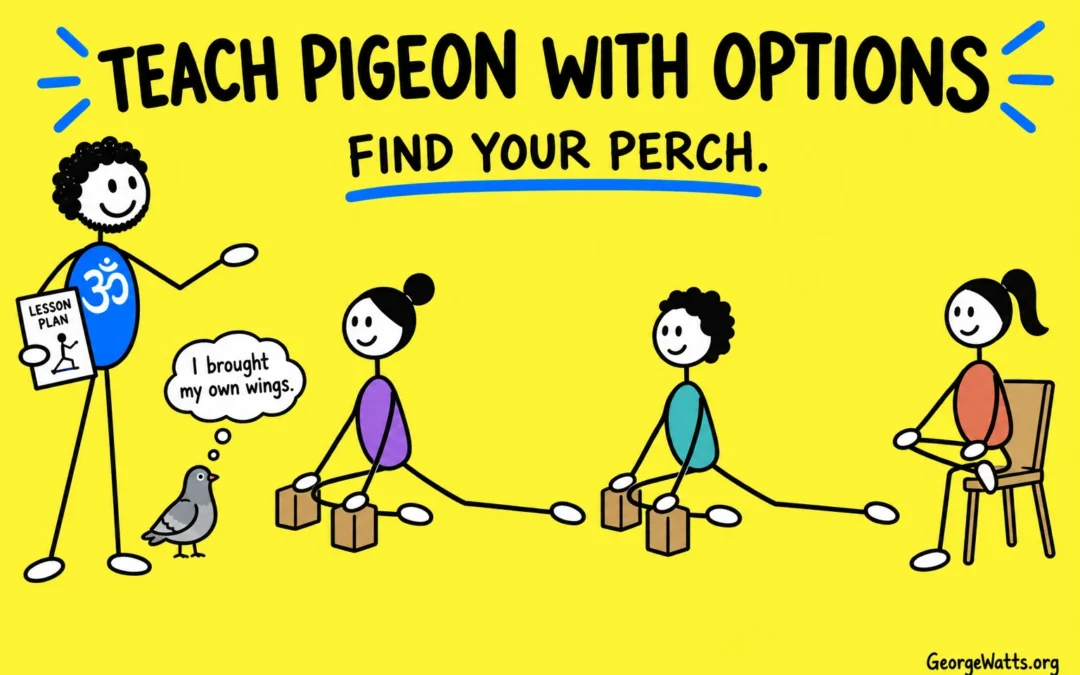
A Pigeon-themed class can be playful and practical. The teaching task is to give students a comfortable route into the exploration, including a route that never involves floor Pigeon at all.
Below are seven teaching steps, useful alternatives and a free two-page cue sheet you can edit for your own classes. The theme is support: different bodies, different perches.
Which Pigeon Are We Teaching?
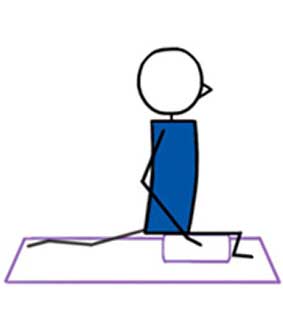
Start with Half Pigeon. This post covers the upright or supported floor variation, with one leg bent in front and the other extending behind. It is preparation associated with Eka Pada Rajakapotasana, rather than instruction for the full King Pigeon backbend.
The position explores the front hip in flexion and external rotation, with extension at the back hip. Students may notice a stretch around the outer front hip or the front of the back hip. The experience varies; knee pain is not the intended sensation.
There is no need to promise emotional release, perfectly aligned hips or relief from a medical condition. A useful outcome is learning which position and amount of support suit the student today.
Seven Steps for Teaching Pigeon
1. Offer choices first. Introduce supported floor Pigeon, reclined figure four and a chair option before anyone begins. Ask students to follow individual advice about injuries or surgery, particularly involving the hips, knees or back. Rest is welcome too.
2. Prepare with familiar movement. Choose comfortable walking or marching, small Cat–Cow movements and gentle hip movements that suit your group. Reclined figure four can help students explore a related shape before deciding whether to try floor Pigeon. Preparation does not guarantee that a pose will suit everyone.
3. Arrange the front leg. From hands and knees, bring the right knee towards the right wrist. Let the heel stay near the left side of the pelvis. The front shin can remain diagonal. Do not pull the foot forward to make a parallel shin.
4. Support before lowering. Slide the left leg back within a comfortable range. Add a folded blanket or bolster beneath the right side of the pelvis if needed. Keep hands on the floor or stable blocks. Avoid forcing the pelvis square or pushing it towards the floor.
5. Check the experience. Invite a manageable hip stretch and ordinary, easy breathing. Knee pain, sharp pain, pinching, numbness or tingling means come out. Do not ask students to breathe through joint pain or keep adjusting while it hurts.
6. Choose height and time. Staying upright is an option. Folding forward is optional and may use torso support; stop before strain. Begin with a few comfortable breaths and make leaving early easy. Keeping props is a valid choice at every level.
7. Leave with control. Press through the hands and lift enough to free the front leg, returning slowly to hands and knees. Offer help planning a different transition if needed. Pause before exploring the other side, which may need different support or a different option.
Practical Alternatives and Support
Reclined figure four. Lie on the back with knees bent and feet down. Rest one ankle on the opposite thigh, above the knee. Keep the supporting foot down, or hold behind that thigh and draw it closer only if comfortable. Avoid pushing the crossed knee away.
Chair figure four. Use a stable chair with feet supported. If accessible, rest one ankle on the opposite thigh without pulling it into place. Stay upright or hinge forward slightly from the hips. If crossing the leg is uncomfortable, keep both feet down and choose another movement.
Supported floor Pigeon. Support the front side of the pelvis and use stable hand supports. Choose a height that feels steady. A prop is useful equipment, but it does not make a painful pose safe.
Amber Karnes’ Pigeon modifications demonstration offers another look at adapting support to different bodies. Use demonstrations as ideas to assess with your students, rather than shapes everybody must copy.
Stop when needed. Do not push a student’s knee, foot or pelvis into place. Foot position alone cannot guarantee knee comfort. Persistent or recurring pain, numbness or tingling needs assessment by an appropriate health professional.
A Pigeon Theme That Helps
Keep the metaphor light. You do not need a long list of bird facts. Choose one image that supports a useful teaching decision.
- Find your perch: invite students to choose a position where they feel supported.
- Build your nest: make arranging blankets, blocks or a chair part of the practice.
- Choose your route: remind the group that different variations can belong in the same class.
Try saying: “Your perch may look different from your neighbour’s. Find the support that lets you breathe comfortably.”
These are playful teaching metaphors. Students do not need to feel peaceful, release an emotion or identify with a bird. The pigeon can stay in the story.
Build a Short Class Segment
- Prepare: choose familiar, comfortable movements appropriate for your students.
- Explore: demonstrate the reclined, chair and supported floor options before students choose.
- Pause: leave the pose, settle in a comfortable neutral position and notice how it feels.
- Reflect: ask “What support helped?” and use the answers when planning the next class.
Adapt the time to your group. A shorter stay or a different pose is a teaching choice, not a failed attempt. For more planning ideas, explore my free hip-openers chart and class plan.
Download the Free Teacher Cue Sheet
The two-page download includes the seven teaching steps, three practical options, a class-segment outline and space for your own notes. Both versions are editable and use white pages for printing.
Your Pigeon Pose teacher cue sheet
Download the Word cue sheet (.docx) ↓
Download the LibreOffice cue sheet (.odt) ↓
George’s Conclusion
Teach the options. A useful Pigeon-themed class gives students clear instructions, support and permission to choose a different shape. That is more valuable than a room full of matching shins.
Take the cue sheet, pick a theme and leave room to adapt. Percy the Pigeon can manage his own wings; you can concentrate on the people in front of you.
